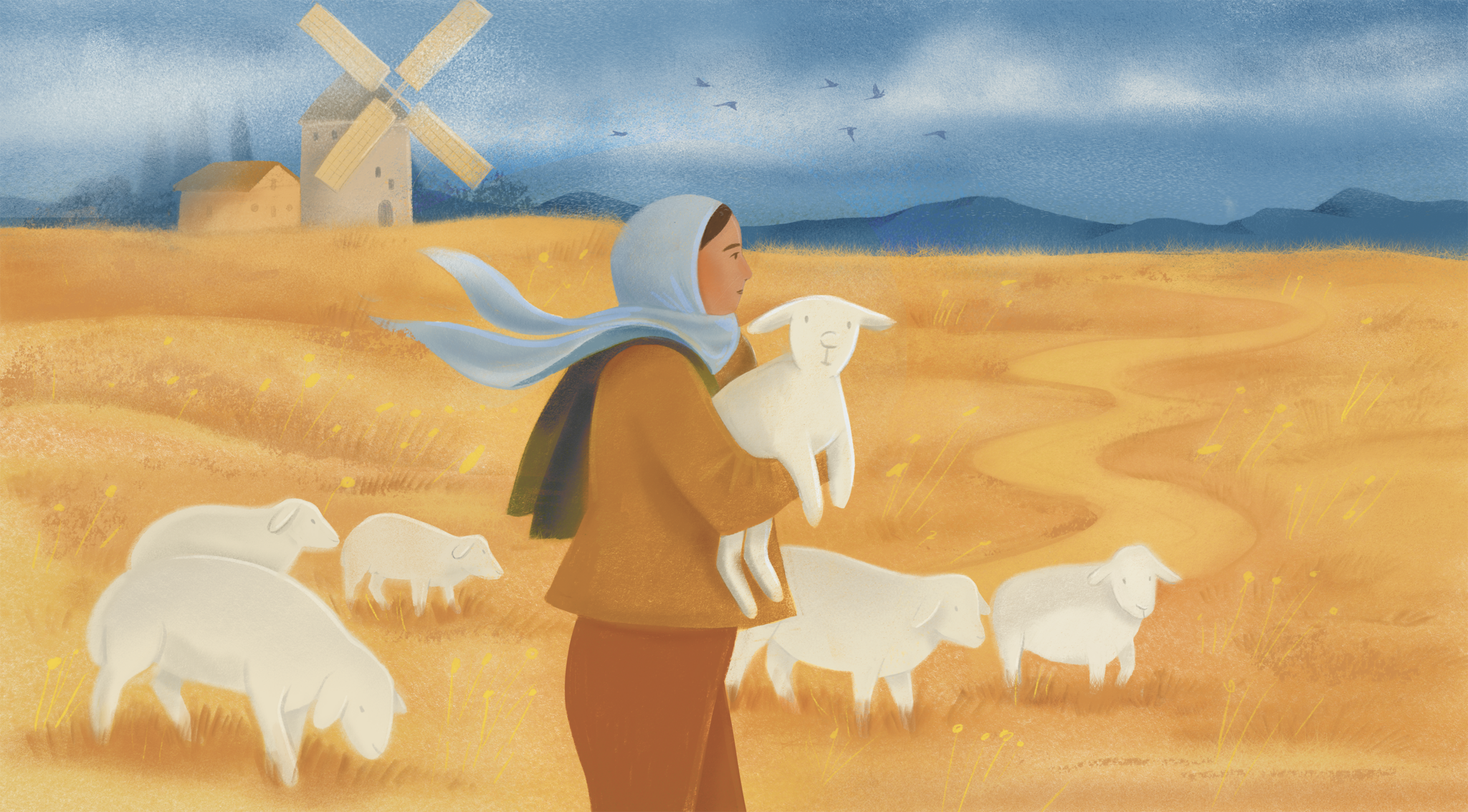
Halima has been on the farm in Albacete for two months. She already knows that the best part of the job is when lambs are born healthy and easily. Over two weeks, some 800 ewes have given birth here. Usually, they manage by themselves. “If it gets complicated, we help,” Halima says. The hardest part of her job is when lambs refuse to feed: “It’s sad and stressful. I cuddle their back and chest like you do with babies and I try to make them suckle. If not, they will die.”
Some ewes have more than one lamb at a time, even three or four, and can’t nurse them all. They go to the nursing pen, which is sectioned off for lambs of different ages. There are lambs suckling from teats installed on the walls. Others nap together in wooly heaps. Zoubia is in charge here. She used to work for the Red Crescent in Morocco. “It’s not so different,” she says. “It’s like a hospital.”
Zoubia arrived in Spain a year and a half ago, hoping to validate her nursing assistant diploma, but she must improve her Spanish first. “In the meantime, I like to work with animals. After all, we are animals, too,” she says. Zoubia’s father recently passed away, and she has been sending money to her mother and her sister. Halima is also from Morocco but has been in Spain half her life, working in care for the elderly. Her current job is better paid and less precarious.
Farming used to be work that stayed in the community, passed down through families. That doesn’t happen so much anymore. Albacete, like much of rural Spain, is experiencing depopulation. Shepherding was also, for the most part, men’s work. But Halima and Zoubia’s boss, Victor, is happy to employ women to watch over his sheep. “I don’t know if it’s the maternal instinct, but women have more patience and empathy with them than men,” he says.
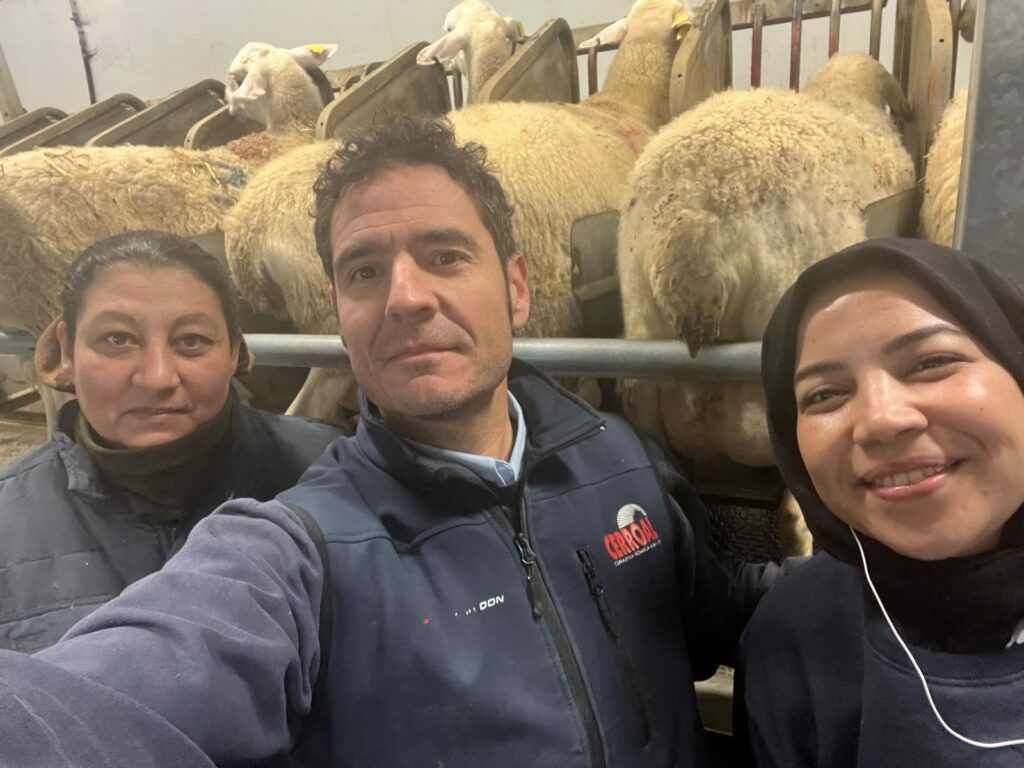
Of the three women shepherds on the farm – alongside ten male workers – Irina has the most experience with animals. Two decades ago, she moved to Albacete from Romania and married a Spanish herder twice her age. “He taught me everything about ruminants,” she says with obvious feeling; he recently passed away. Now, she works for Victor to support her two teenage children.
Irina’s first contact with animal husbandry was on her grandparents’ farm in Romania, where the small herd of sheep and goats they kept for subsistence grazed lush green mountains. The grazing here in Castilla La Mancha is different: yellow expanses of plateau and steppe scattered with low scrub and the occasional stand of forest tough enough to withstand drought.
This is the landscape where Don Quijote embodied justice, courage and medieval chivalry – which already seemed quaintly archaic when Cervantes set his novel here four centuries ago. Then as now, people wrote off traditions that had yet to live out their worth. But the pastoralists keeping time-honored traditions alive here today aren’t driven by nostalgia; their foe are not illusory giants, but the decline of dignified rural livelihoods, and of our soils, biodiversity and climate.
‘I couldn’t have been a mother in a city’
When Maria Helena started out in the 1980s, farmers in Spain wouldn’t put women shepherds on contracts. But she found informal, seasonal work. That suited her. Maria Helena has always associated pastoral living with liberty.
“Sometimes there wasn’t a chimney, but we’d make a fire in a corner. We had horses to carry up food and clothes, but sometimes we carried everything on our backs during the night – even while I was pregnant.”
Maria Helena
She grew up near Paris. Over summers in the mountains with her brother, who had a herd of dairy cows, Maria Helena learnt to shear sheep without tying them down: skilled work that kept her employed for a decade of her youth. She traveled from farm to farm with a group of friends. “Farmers would let us stay in the stable with the straw. It was quite an adventure,” she remembers.
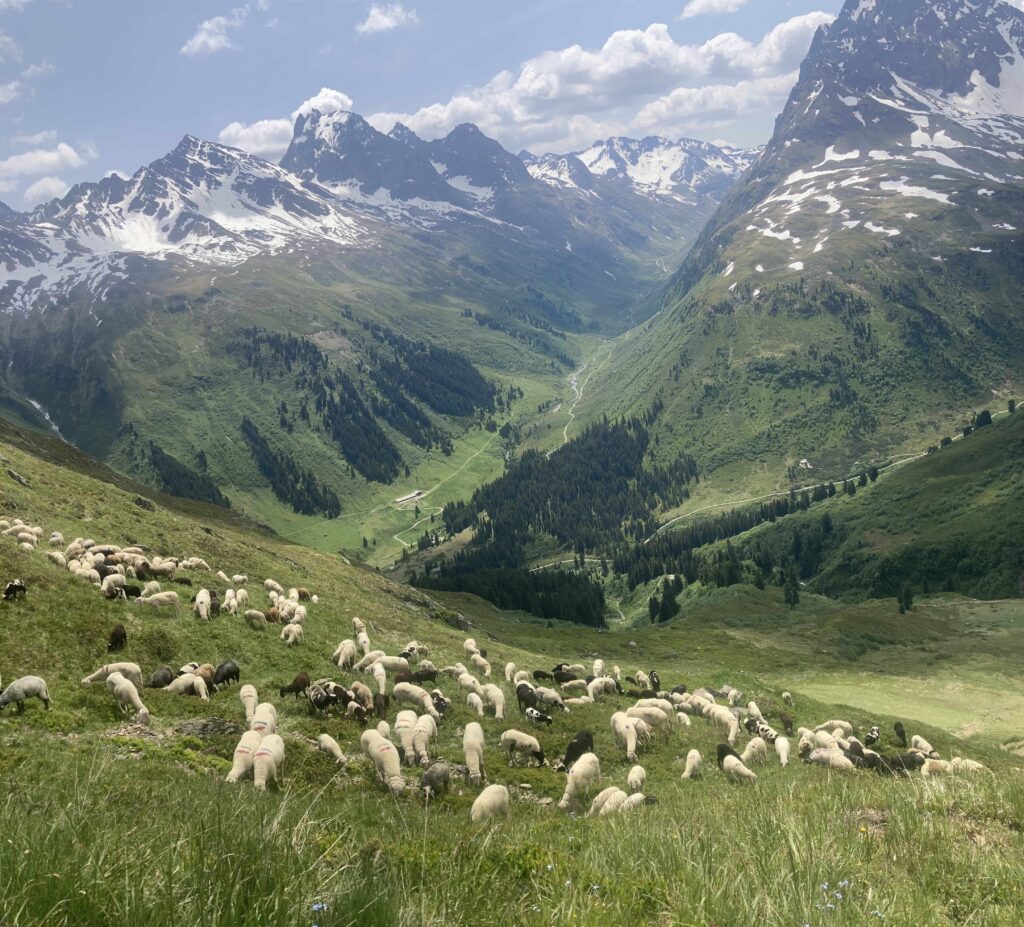
Later, Maria Helena herded sheep in the Pyrenees. From winter to spring, the animals stayed on farms. In summer, herders took them up to the mountains to graze. “We had tiny, old huts,” she recalls. “Sometimes there wasn’t a chimney, but we’d make a fire in a corner. We had horses to carry up food and clothes, but sometimes we carried everything on our backs during the night – even while I was pregnant.”
Maria Helena’s three daughters were born in France. Then she moved to Spain and had three boys. “I couldn’t have been a mother in a city,” she says. She brought all her children to pasture with her. Her eldest daughter came up strapped to Maria Helena’s back when she was just three weeks old.
Spain was emerging from dictatorship when Maria Helena made her base in an economically depressed valley in Aragon. “There weren’t other people like us, but the older farmers were respectful because during the [Spanish Civil] War, many women had to work alone with many sacrifices, as men had gone off to fight,” she says. She also found in Spain greater respect for the animals. “The farmers would walk two hours uphill to come back down carrying a sheep with a broken leg on their backs. In France, they’d tell us, ‘Kill it.’”
‘Extensive farming can mitigate climate change’
Rural communities across Europe have long been in decline as men like Victor, who took on the land his father and grandfather farmed before him, turn instead to urban careers. But now there are shepherds coming to pastoralism with motivations beyond family heritage. Some even have university degrees, Maria Helena says.
Two of Maria Helena’s sons and one of her daughters are now shepherds. It was through her youngest, Zacarias, that she met Celia and Zuriñe, to whom she has become a mentor. Celia studied the science of organic farming in Kassel, Germany, before enrolling in a shepherding school in Spain. Zuriñe studied biology and has a master’s in organic farming and livestock. The pair now run an Instagram account, Pastoras Nómadas, to raise awareness of their work. “We’re not influencers,” Celia says, “we are shepherdesses who want to smash the stereotype that rural life and herding are over.”
Celia and Zuriñe believe pastoralism has a future because of its ecological value. They are frustrated by how livestock farming is talked about in environmental debates, and by the idea that eating meat isn’t sustainable. The Alpine pastures where Celia and Zuriñe graze their flocks – or Victor’s scrubby land – aren’t suitable for arable farming. “Livestock use ecosystems that otherwise would be completely degraded and provide food with extremely high nutritional value,” Celia says.
“People always lump extensive and industrial livestock together, but they’re completely different,” she explains. Intensive, industrial farming took off in the mid-20th century, when mechanization, artificial fertilizers and processed feed meant more meat and milk per hectare of land. What it has gradually replaced, is extensive livestock farming that relies on woodlands, natural pastures and stubble fields, and can be an integral part of healthy ecosystems.
The landscape of the Iberian Peninsula has been shaped by thousands of years of pastoralism. Farmers began thinning out saplings and undergrowth, allowing grasslands to flourish under oaks, feeding their animals and being fertilized by their dung, as far back as the Neolithic era. Through Roman and medieval times and up to the present day, these dehesas thrived as a balanced ecosystem, sustaining wild plants and animals as well as people and their livestock, across thousands of kilometers of Portugal and Western Spain. “They are home to dozens of endemic species, flora and fauna, that would disappear without livestock,” Celia says. “Ruminants help clean the mountains of undergrowth to prevent fires. Additionally, the herds disperse seeds through their wool, hooves, and manure.”
Celia argues that greenhouse gas emissions from livestock are also misunderstood “Ruminant methane is part of the natural CO2 cycle.” When grazing animals belch out methane, which contributes to global warming in the short term, but remains in the atmosphere for only about a decade as it oxidizes into water and CO2, which is turn fixed by plants – converted into carbohydrates through photosynthesis – closing the natural carbon cycle. This is very different from emissions from fossil fuels, Celia argues, which are extracted from the subsoil, adding extra carbon to the atmosphere that throws the cycle out of balance.
“Extensive livestock can help mitigate climate change. Well-managed pastures can store more carbon than forests. Rotational grazing improves soil health, increasing its capacity to retain water and carbon,” Celia says. But the EU’s Common Agricultural Policy (CAP) doesn’t incentivize preserving natural and carbon cycles – instead, it rewards maximizing yields through farming that depends on fossil fuels to reshape the land to produce high-intensity feed.
Celsa Peiteado Morales, head of WWF Spain’s Food Program, gives an example from La Vera, in the semi-arid Spanish region of Extremadura where dehesas make up around half of agricultural land. Farmers in La Vera receive €1,229 in Basic Income Support for every hectare of land they irrigate to produce water-hungry crops. For every hectare of pasture where livestock feed on vegetation without added water and chemicals, they receive just €56. But, because aid is linked to land area, the number of livestock and historic grazing rights, the forest, livestock trails, fallow land and stubble fields where most pastoral grazing takes place aren’t eligible for the basic payment at all. Intensive agriculture gets a bigger proportion of CAP subsidies than extensive livestock farming, benefiting large companies and landowners, rather than small and medium-sized producers.
Extensive agriculture gets a bigger proportion of CAP subsidies than extensive livestock farming – this tends to benefit large companies and landowners, rather than small and medium-sized producers.
‘At 2,500 meters, everything is connected’
The most expansive pastoralism of all is transhumance, the ancient practice of long-distance herding between different climatic regions. Across Europe, shepherds still move thousands of animals from lowland winter grazing to summer pastures in high Pyrenees, Alps and Carpathian Mountains, or along Spain’s networks of drove roads. They guide their flocks on foot or horseback, accompanied by their dogs and sometimes their families. Celia and Zuriñe practice trasterminance: shorter journeys, of less than a hundred kilometers, down into the valleys and up again, or between pastures at the same altitude.
The horses of Maria Helena’s youth have been replaced by helicopters to transport food, firewood and luggage to huts beyond the reach off-road vehicles. But, Zuriñe says, “your tools as a herder are the same: you and your dogs. It requires a lot of observation to know which direction sheep are going to move in or stay together.” And most huts still have no mains power or running water. “It’s minimalism, going back to the essentials.”
Zuriñe spent four months last summer leading a ‘collective flock’ of some 350 sheep belonging to fifteen farmers in Austria. “One of the challenges with this type of flocks is ‘fowling’ them together – they do tend to wander off,” she says. Another challenge is isolation. “There are times when you’re tired, you want to talk to family and friends, it’s raining, and it’s tough.” But there are also benefits to leaving behind the constant distractions of modern life: “Hyper-connectivity isn’t good. It’s healthy to use your body for something meaningful. It gives you strength and mental clarity,” Zuriñe says.
Zuriñe’s final degree project was on livestock predators. For centuries, protecting the flock from predators was at the heart of the job. But by the mid-19th century, wolves were considered extinct in Austria. Farmers abandoned active herding and the use of guard dogs. “Now, the wolves’ population has increased,” Zuriñe says. Wolves with access to easy prey will kill more than they can eat, she explains, “causing more damage than a bear.”
At night, Zuriñe her keeps her flock safe between electric fences – a modern practice of which Maria Helena is skeptical: “That’s why it’s become more difficult to herd livestock,” she says. “Sheep have lost the habit of being guarded in the mountains with humans and dogs.”
“It’s unique, it can’t be explained. The sheep know you. There’s a constant interaction throughout the day in communion with nature, the climate, wind, air, grass, water, sun and rocks. At an elevation of 2,500 meters, everything is connected.”
Maria Helena
Maria Helena says some shepherds’ huts now are “too comfortable.” A few even have television. When she was young, shepherds didn’t even have radios to tune in to the weather forecast. “If there were storms, your body, intuition and the animals would let you know without the need for technology. We were focused on how they experienced each day. In the mountains, you receive the information you need. If the branches or clouds moved a lot one night, the elders said, ‘We’ll have rain in two days.’”
These predictions weren’t always reliable, Maria Helena admits, but “it’s not an intellectual way of processing things. You feel them. It’s an ancestral wisdom and knowledge, the ability to read the landscape, the animals, the wind, the clouds, to sense if spring was late or summer was coming early.” For her, pastoralism forges a powerful interspecies relationship that is hard to put into words. “It’s unique, it can’t be explained. The sheep know you. There’s a constant interaction throughout the day in communion with nature, the climate, wind, air, grass, water, sun and rocks. At an elevation of 2,500 meters, everything is connected.”
‘They are fearless women’
Much has changed since Marina Helena’s youth, and much has stayed the same. Four decades after she relocated across the Pyrenees from France to Spain, the ancient lore of land and livestock are still a draw for herders traversing the border, picking up informal work wherever it’s going for the best rate of pay.
Nuria lost her parents when she was a child and was brought to a farmhouse run by a charitable foundation. There was a shepherd nearby and at fifteen she began helping him every morning. At eighteen, she volunteered on organic farms. One had dairy goats. “I really enjoyed it, so I enrolled in the Catalan Shepherds School.”
Six years ago, she moved to Luchon in the French Pyrenees to look after a flock of about 200 sheep. She works nonstop for nine months without a free day. This year’s lambing season has been harder than most because her sheepdog, Flicka, also became mom to six puppies. “Yesterday was a complicated day, she gave birth at night. I didn’t sleep, I took care of herding, feeding and tending to the lambing pens.”
Nuria will go back to Spain next season because labor conditions are now better there than in France. Pay is still less than in Austria, but in Spain Nuria can expect a minimum wage of between €1,200 and €1,400, a day off per week, and perhaps housing as part of her compensation. And the work has its own rewards. “One of the things I like most is the knowledge that’s being lost. I’ve learnt by asking veteran shepherds,” Nuria says.
“Herders used what they had to hand. There’s a trick I like. When sheep get bloated from overeating their stomachs stop. I put an elderberry stick in their mouth. I peel it and tie it to their head so it’s in their mouth – like a horse’s bit – so they chew it, moving their stomach and releasing the air.” Recently, she learnt of another old remedy she hasn’t yet had a chance to use: “There’s an udder infection that sheep catch. It forms scabs and the lambs get sores in their mouths and can’t eat. It heals with the urea from the first urine of the morning.”
Other traditions are best left behind. “It’s a very male-dominated environment,” Nuria says. “I started so young, they treated me as if I lacked ability, with less consideration than a man. I had to put in twice the effort to prove I could do it. It put a lot of pressure on me.” She had to leave one job because her boss touched her inappropriately. But as more women take to the pastures, dedicated support networks are forming. Nuria says the Ganaderas en Red, a Spanish association for female farmers and herders, has become for her like family. “They are fearless women. It’s been like finding great friends and saying, ‘I’m not crazy.’ We share experiences, ask questions. We even do menopause courses.”
Trailer for a documentary about Ganaderas en Red, a network of shephardesses and female livestock farmers “that flows towards a vibrant, fair, and equal rural environment.”
‘For us, becoming herders was a choice’
Maria Helena learnt to shear from an elder shepherd who could tell the age and health of a sheep from a tiny tuft of wool. He told her, “Don’t worry, men have the strength, you have the flexibility and can do it just as well,” she recalls fondly. Now, Zuriñe holds dear a piece of advice Marina Helena once gave her: “You will find your own way. Maybe won’t carry a load of many kilos, but you can make two trips with half that weight, that’s fine,” Maria Helena told her.
Eight years ago, Maria Helena had to retire because of a back injury. It has been a lesson in self-care. “I’ve learnt to listen to myself. A shepherd doesn’t listen to the body or the mind, they only follow the animals’ rhythm, often out of obligation,” she says, drawing a parallel with motherhood. Demands of the land used to mean rural women had little time to rest after giving birth. But you can’t look after others if you don’t look after yourself. “If farmers had time for themselves before they got hurt, they would be kinder to the animals,” Maria Helena says.
For Celia, it’s not hours clocked up in hardship and isolation that make a good shepherd, but a deep understanding of the animals and their environment. “Fitting this ancient profession into the rhythm of modern times can be exhausting,” and it demands both respect and proper compensation, with “rotating breaks, technical support, and fair recognition for sustaining something that is being lost and is still relevant.”
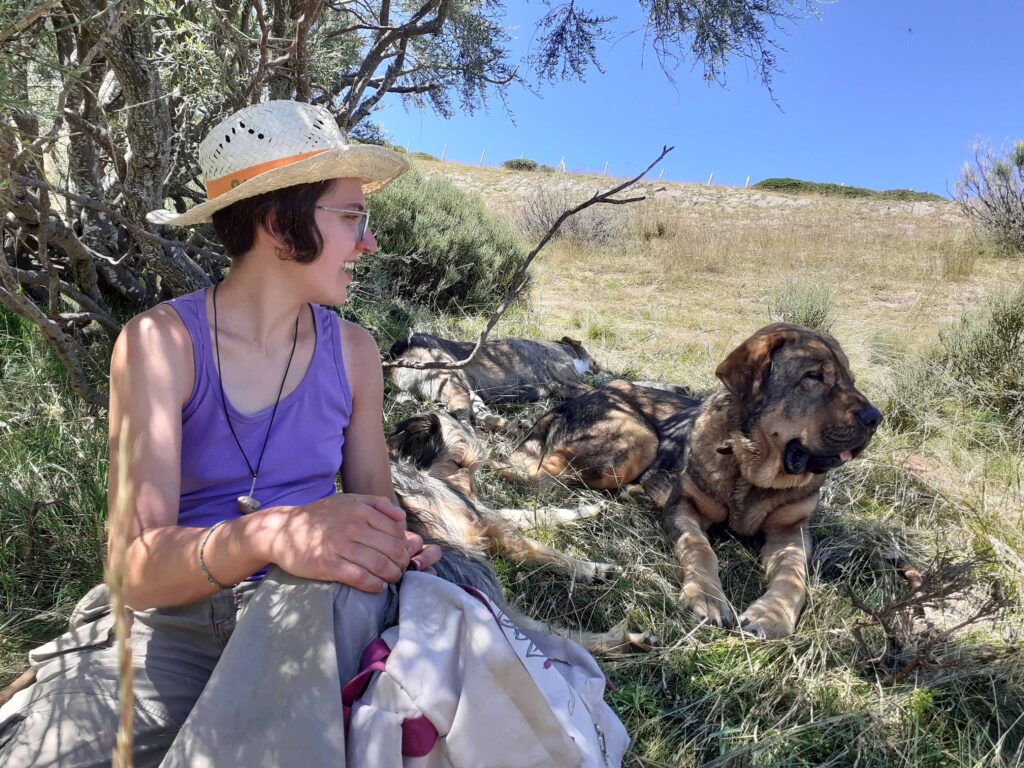
Globally, pastoralism sustains hundreds of millions of people – particularly in arid zones, which cover more than 40 percent of the Earth’s surface. The UN has made 2026 the International Year of Rangelands and Pastoralism to promote investment in sustainable livestock framing, ecosystem restoration and equitable market access. This comes as the EU CAP is under periodic review. The current funding period comes to an end in 2027. So far, EU proposals for a reformed framework from 2028 threaten to downgrade the environmental priorities that do exist. But sustainable farming associations, environmental groups and rural communities are collaborating on proposals to reward quality food, sustainability, ecological and social impacts rather than just mass production, and more CAP support for extensive livestock, which would allow farmers to pay their workers more.
CAP’s current focus on production density is not only hard on the land, but on human labor: it assumes fewer hands to tend to animals in a confined area, and doesn’t pay enough to properly compensate the work involved in extensive livestock farming. “If we want more people involved, we have to dignify it a bit and make it more attractive through better working conditions,” Celia says.
Decent pay and working hours bring dignity. So do traditions that make this work, and the animals themselves, culturally important. Zuriñe finds inspiration in Austrian rural customs. “The cow is the queen in the Alps,” she says. “Yodels are sounds to call the cows in the mountains. Each farmer has their own, and from yodeling come traditional songs.” At the end of the summer, there’s a celebration called Almabtrieb. “The cows are brought down from the mountains and adorned with flower crowns. A small fair is held in the town, and music is played. It’s beautiful – and it’s also fading away.”
Flower crowns, elderberry twigs and forecasts that rustle through the treetops have no place on farms where livestock are pumped full of antibiotics and workers are hired not for their sensitivity to animals’ needs but their readiness to work up close to animal suffering for long hours and low pay.
“The agrifood system has a highly unequal structure that thrives on the invisible and precarious labor of thousands of migrants. For us, becoming salaried shepherds was a conscious choice,” Celia says of the Pastoras Nómadas. “We do it out of vocation and enjoyment. We are privileged, we have chosen, but we are aware that many other women haven’t.”
There is no official European data on the exploitation of migrant workers in livestock farming, but it is intensive agriculture where these cases are most frequent. In Italy – and, less frequently, in Spain – there are reports of forced labor, modern slavery and violent abuse livestock laborers.
‘Livestock keeps people in rural areas’
“Pastoralism is about caring, like with the elderly,” Halima says. Women, she believes, know how to care, “even if they are childless like me.” She didn’t come to Europe planning to work in farming. Until recently, her knowledge of lambs was limited to the centerpiece at Eid feasts. Now, she knows how to massage an ewe’s teat to collect the fat that characterizes traditional Manchego cheese.
Victor’s flock of 3,500 sheep and goats produces 5,300 liters of milk every two days. He sells it to a large company that pays based on ’cheese extract’: the percentage of fat and protein. Victor and all his employees take a day off each week. He took over after his father died in an accident with the herd, and has no intention of working himself to death. As president of the Albacete Livestock Exchange market, he is also working to ensure transparency over commercial transactions between farmers, processors and distributors. Every Thursday, local farmers gather to set prices for meat and live animals.
Traditional producers like Victor help keep Albacete’s villages from being deserted. “Livestock farming keeps people in rural areas,” he says. “You have to be around the animals, no matter what.” But farms like his wouldn’t survive without CAP subsidies.
“We depend on the markets, on how much we are paid for milk and meat, and what we are charged for feed, energy, and so on.” In 2024, markets were profitable. “If everything were worth what it should be, and every year were like 2024, we wouldn’t need the CAP,” he says. But in 2025, milk prices fell, and he would have made a loss without it. “We need CAP to be reformed to provide further and better support for small and medium farmers and provide better conditions to our workers and ecosystems.”
About the author:
Brenda Chávez is an investigative, data and solutions journalist working on the intersection of sustainability, human rights and supply chains, and committed to journalism for social and environmental transparency.
This story is part of an investigative journalism project funded by Journalismfund Europe.
What are ultramarins? How many colonies does France have? Do people in French territories have French citizenship or nationality?