

On 2 September 2025, Vietnam celebrated 80 years since its communist government declared independence from European colonial rule. There were celebrations across the country and thousands of troops took part in military parades in Hanoi’s Ba Đình Square.
A week earlier, the government had made pledges in support of its bid to join the UN Human Rights Council – promising to work with the council on “the rights of vulnerable groups and the impacts of global issues, such as climate change and digital transformation, on the enjoyment of human rights.”
Between these two public events, something else happened with far less fanfare: according to reports from various human rights organizations, police quietly detained several environmental activists – apparently without charge.
The US-based Vietnam Civil Rights Project says police failed to present any arrest warrants for Hồ Sỹ Quyết, Trần Quang Trung, Trần Quang Nam, Nguyễn Tuấn Nghĩa and a man known as Khánh, who are now all in police custody. Three weeks later, human rights group Defend the Defenders reported that Vietnam’s security forces had yet to inform the five detained activists’ families of their whereabouts, or the charges against them.
The activists had all been campaigning on environmental issues – including the 2016 toxic chemical discharge in Ha Tĩnh province linked to Taiwan-based firm Formosa Ha Tinh Steel, and the government’s 2015 plan to fell ancient trees Hanoi. Family of the detainees were warned not to contact independent media as the arrests were said to pertain to national security.
Despite Vietnam’s apparent enthusiasm for international human rights initiatives, the persecution of eco-activists is no surprise to anyone familiar with the country’s recent record. Between 2021 and 2023, six climate activists – Mai Phan Lợi, Bạch Hùng Dương, Nguỵ Thị Khanh, Hoàng Minh Hồng, Đặng Đình Bách and Ngô Thị Tố Nhiên – were arrested.
All six were involved in the international Just Energy Transition Partnership (JETP), a high-profile green funding initiative backed by major international partners. To varying degrees, each had been critical of the state-owned coal industry and championed rights-based approaches toward the JETP. Five were imprisoned on trumped-up charges of tax evasion and one for “appropriation of information or documents.” Four of the JETP six have served their sentenced and have since been released.
The difference between the JETP six and the more recent arrests is that while the former drew widespread international attention and condemnation, the detention of the five activists in August has been met with near silence.
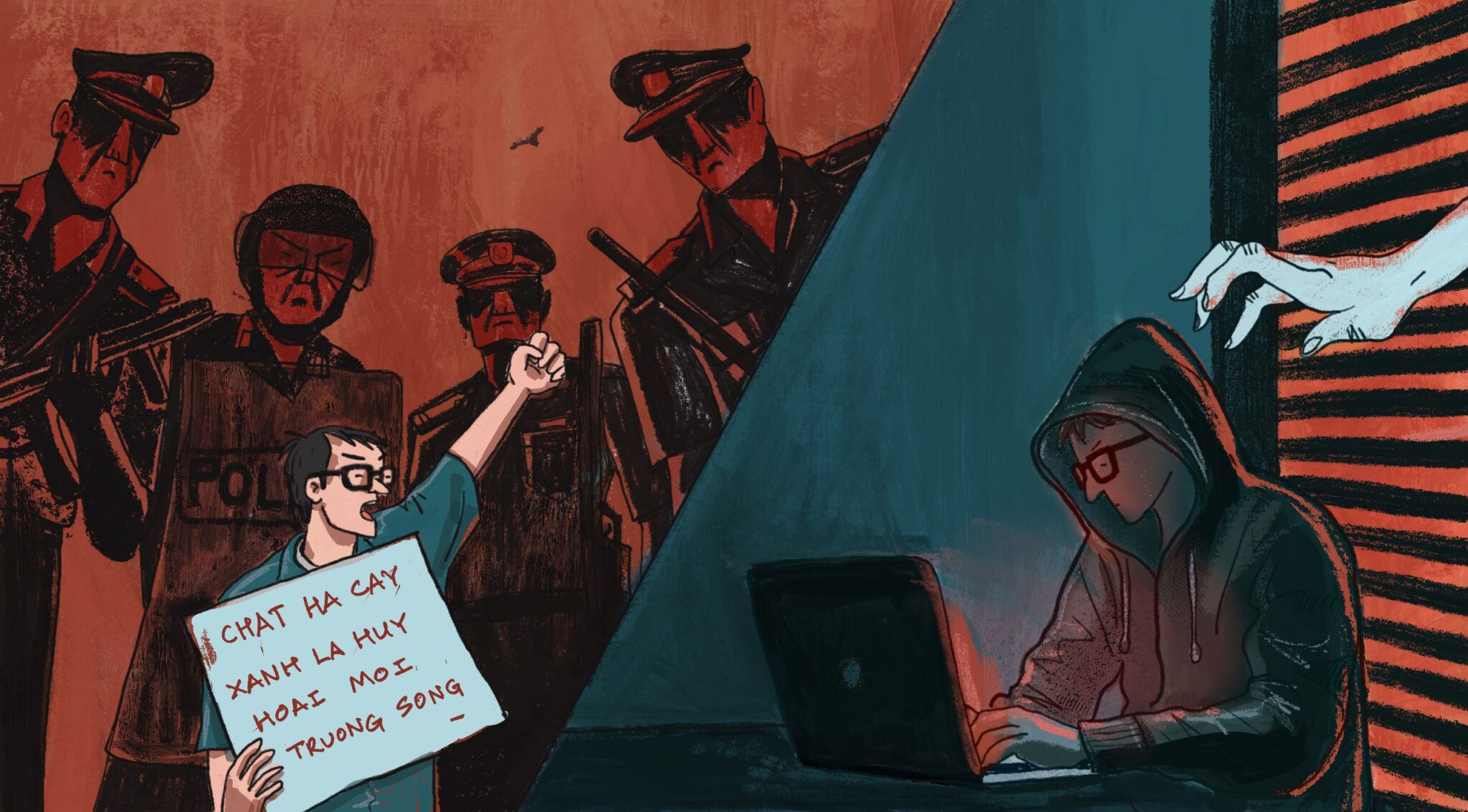
Vietnamese activists often find themselves between a rock and a hard place. It has become clear that even working on international programs like JETP with major NGOs puts activists at risk of arrest. Yet working under the radar – as the independent campaigners arrested ahead of the anniversary celebrations had been – could be even more dangerous if you are arrested.
Phạm Thanh Nghiên, a blogger and former prisoner of conscience who now lives in exile in the United States, says keeping a low profile and carrying out campaigns anonymously can allow activists to accomplish more without “surveillance and interference.”
“But if secret activities are discovered by the police while the public remains unaware, the danger becomes much greater,” she says. “One could be arrested, tortured, subjected to staged accidents, or even eliminated – depending on the level of activity – without anyone raising their voice or intervening.”
“One could be arrested, tortured, subjected to staged accidents, or even eliminated – depending on the level of activity – without anyone raising their voice or intervening.”
Phạm Thanh Nghiên
Control, intimidation and arrests
Independent NGOs cannot operate legally in Vietnam: all such organizations must be registered under a state agency, and even if their application is successful, all their activities are then subject to state approval.
Yet the two JETP detainees who remain in prison – environmental lawyer Bách and policy researcher Nhiên – are former civil servants and leaders of state-sanctioned NGOs. The JETP itself is major clean energy financing mechanism backed by the International Partners Group composed of the EU, the UK, the United States, Japan, Germany, France, Italy, Canada, Denmark and Norway. It aimed to bring $15.5 billion of investment in programs and infrastructure to help Vietnam – one of the world’s biggest coal importers – transition away from fossil fuels.
However, there has also been a string of less high-profile arrests of independent online campaigners and citizen journalists on charges of “anti-state propaganda.” Some have been given long prison sentences – such as Lê Đình Lượng, who had been reporting on the marine life disaster caused by Taiwanese company Formosa, and was sentenced to 20 years.
Other activists have been intimated into ceasing their work. Several young members of Green Trees, an informal environmental non-profit founded in 2015, were reportedly harassed by the local authorities and even surveilled by local police at school. As of 2025, the group is no longer active.
Visibility or silence
Đoàn Bảo Châu, a well-known martial artist, journalist and author, had been using Facebook to call out Vietnam’s government over issues such as corruption of grassroots humanitarian aid and poor disaster relief work, as well as police violence and the criminalization of activists.
In July, police stormed his home while he was away and charged him under Article 117 of the Penal Code, which criminalizes “making, storing, disseminating or propagandizing information, materials and products that aim to oppose the State of the Socialist Republic of Vietnam.”
In August 2025, a national arrest warrant was issued for Đoàn while he was in hiding. Nevertheless, he continued to livestream and post daily Facebook updates. Đoàn says he has been the target of numerous cyberattacks, and that security agents pretended to be participants in his martial arts classes – predictable consequences, he says, of openly confronting the regime.
Asked in an email how activists should protect themselves, he warned that police are more likely to target those with a public profile. “If they do not want to be arrested, they have to be careful to choose what to publish, what not,” Đoàn writes. “Also, the risk of being arrested increases when they become well known.”
Yet as the state cracks down on online activism, it is also becoming harder for targets of state oppression to get their story out, and low-profile activists might be at risk of disappearing without a trace. Phạm Thanh Nghiên says the public and their peers may not know what has happened to them, and limited information makes it harder for international organizations to offer support.
In 2008, Nghiên was imprisoned on charges of spreading anti-state propaganda for her activism calling for human rights and democracy in Vietnam. Initially, she had covertly gathered information on human rights violations in Vietnam and published articles under various pseudonyms, until geologist Nguyễn Thanh Giang and writer Nguyễn Xuân Nghĩa – who were both mentors to her before being imprisoned for their own activism – advised her to go public as a means of self-protection.
Human rights activists who make their identity and work public “risk of harassment or imprisonment,” Nghiên says, but “being in the spotlight of both domestic and international audiences creates public pressure that forces the authorities to think twice before cracking down.”
“Public engagement also helps prevent isolation,” she adds, “allowing activists to connect with like-minded individuals, build personal credibility and establish a support network. It creates conditions for the movement to grow, inspires others and draws attention from human rights organizations.”
"Being in the spotlight of both domestic and international audiences creates public pressure that forces the authorities to think twice before cracking down."
Phạm Thanh Nghiên
Getting the word out
Gerthie Mayo-Anda, a professor at the Palawan State University College of Law in the Philippines with over 25 years of field-based practice in environmental advocacy, says activists should try to be part of a network so they can access support if any legal case is brought against them. “If you are alone, your case is likely to be ignored by the community and the society at large,” says Mayo-Anda.
Lia Mai Torres, executive director of the Asia Pacific Network of Environmental Defenders (APNED), which promotes mutual support among environmental activists, points out that such networks can extend across borders. APNED’s “visibility for protection strategy,” Torres explains, releases statements and information on defenders’ cases via a network of different organizations, “especially when organizations who are at risk feel that their security situation will worsen if they do so [themselves].”
Nghiên says families have been afraid to speak up about their loved ones’ cases, due to harassment by local authorities. “Over the past few years, families of arrested or harassed activists have chosen to stay silent, and even out of touch with dissident communities, for fear of retaliation,” says Nghiên, whose sisters in Vietnam have been harassed by Vietnamese authorities since she relocated to the US.
Nghiên recently started a Youtube channel presenting profiles of activists to save them from public obscurity. In her first video, she reported on the case of Phạm Minh Vũ, a young unaffiliated activist from Quảng Trị province who was sentenced to five years in prison.
Nghiên cautions that going public might not be a model for everyone to follow but she believes that doing so provided her with both peer and international protection. “To me, every contribution, every voice from ordinary citizens working toward the country’s transformation – whether openly or in secret – is deeply valuable and worthy of respect,” she stresses.
Empty promises on human rights
The dilemma over whether or raise your head above the parapet or stay below the radar might be less fraught if activists knew that sounding international alarms would provoke a forceful response. Nguyễn Bá Tùng, executive director of the US-based Vietnam Human Rights Network, says more international pressure is needed to push changes to repressive laws, such as full abolition of death penalty in Vietnam.
“The main reason why Vietnam has abolished some crimes that could lead to the death penalty in recent years is international pressure,” says Tùng. “Governments and international human rights organizations need to continue to increase that pressure.”
Human Rights Watch recommends six priority areas the EU should focus on regarding the deteriorating human rights situation in Vietnam – including protection of environmental activists. Yet when Vietnam announced its candidacy for re-election to the UN Human Rights Council in December 2024, the EU made no objection.
In fact, that same month, it released an additional 15 million euros in budget support to the government of Vietnam as part of the EU-Vietnam Sustainable Energy Transition Programme, which aims to support implementation of the JETP – despite two Vietnamese green energy champions in the JETP program remaining imprisoned.
In February 2025, organizations including the Vietnam Committee on Human Rights, Christian Solidarity Worldwide and Global Witness filed a complaint with the European Commission’s trade department that Vietnam’s actions against activists advocating for sustainable development violated the EU-Vietnam Free Trade Agreement (EVFTA).
Yet Võ Trần Nhật, vice-president of the Vietnam Committee on Human Rights, is not hopeful that human rights issues will have much impact on the implementation of EVFTA “due to the European Commission’s very complacent policy towards Vietnam.” Võ says that in off-the-record conversations around the EU-Vietnam human rights dialogue, the European Commission essentially implied that there is “no point in NGOs denouncing cases of violations or suggesting measures to urge Vietnam to guarantee fundamental freedom.”
About the author:
Hướng Thiện writes about human rights in Vietnam and beyond.
Read this article in Vietnamese.
What are ultramarins? How many colonies does France have? Do people in French territories have French citizenship or nationality?