Rebuilt by workers: How the laid-off workforce of a car parts factory changed labor rules in Italy
- Written by Noa Jaari and Monica Pelliccia
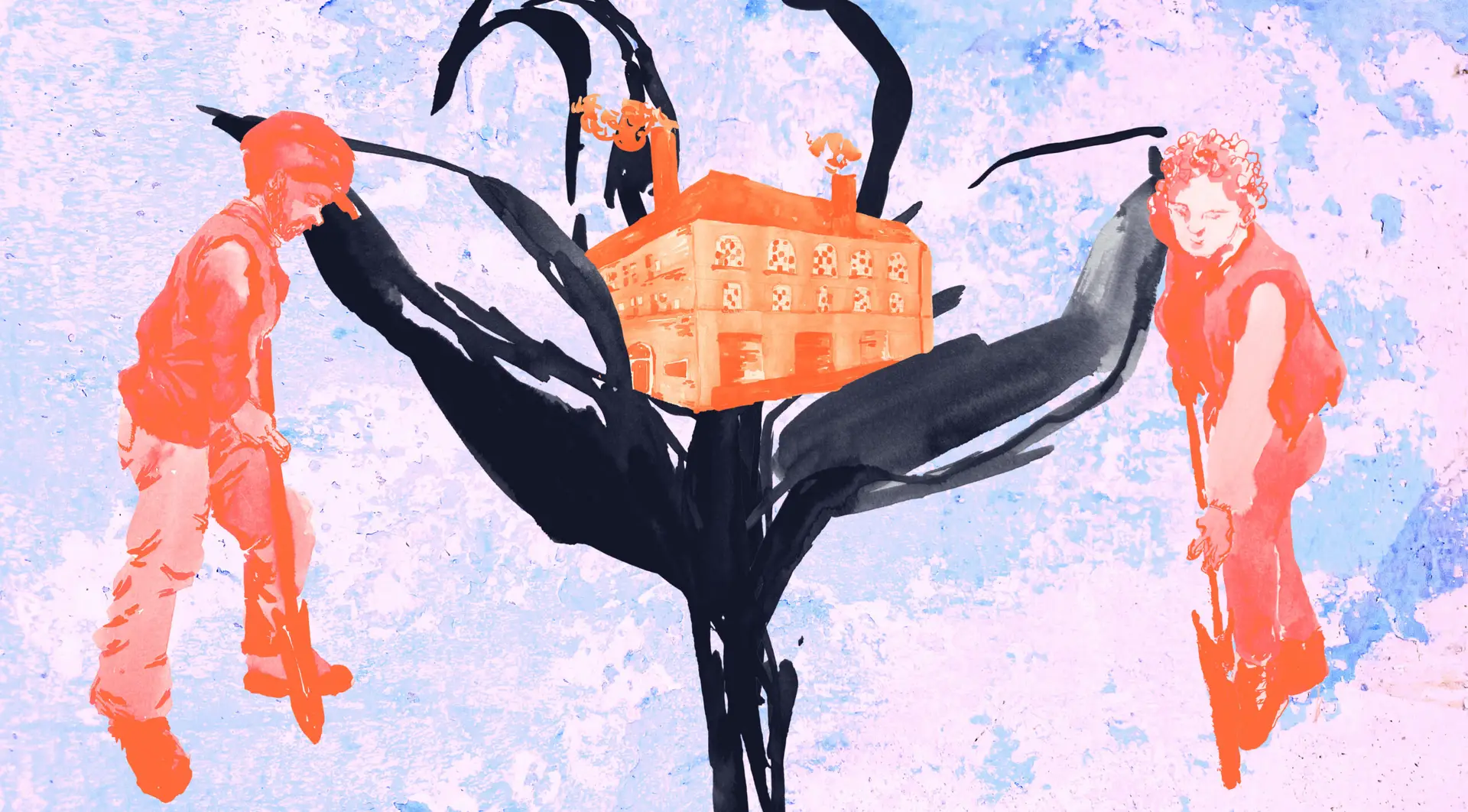
- Illustration by Smaranda Tolosano
Follow us here:
Key strategy: Labor Organizing
Labor organizing involves bringing people together as part of a shared workspace or profession to jointly bargain or advocate for better conditions, wages or rights. Taking many different forms throughout the world, typical types of organizing include forming workers unions, striking for better conditions, and raising awareness in the wider community.
Key strategy: Economic Democracy
Economic democracy seeks to provide alternative models of private ownership, production, and decision-making. Instead of private individuals, corporations and their shareholders wielding power over what is produced and how profits are spent, workers and public stakeholders decide collectively. Examples of economic democracy include the fair trade movement, public investment banks and worker-owned collectives.
Key tactic: Hunger Strike
A hunger strike is a form of non-violent protest wherein participants fast in order to draw attention and build pressure for a specific political outcome.
Key tactic: Legislative lobbying
Legislative lobbying is ecompasses activities designed to bring about the passing (or defeat) of a certain law. Providing draft legislation, meeting with elected officials, organizing advertising or informational campaigns about the law or laws are all part of the process. Both civil society organizations and private companies and individuals can engage in lobbying.
A permanent assembly is a strategy that allows workers to maintain control over a production site and is based on the Italian fundamental right of freedom of assembly, protected by the Constitution in Article 39.
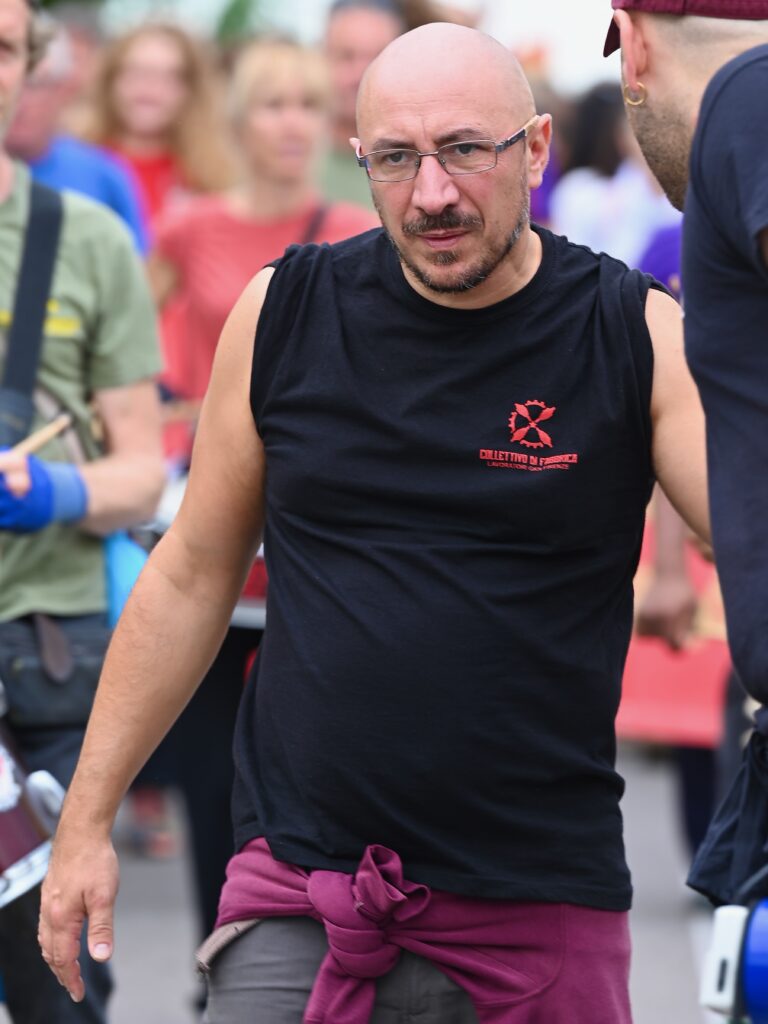
Every day, 46-year-old Dario Salvetti and other former workers of the GKN car parts factory organize shifts to keep the permanent assembly running – even though production at the factory has stopped. Four years have passed since owners shut down the factory in Campi Bisenzio, on the outskirts of Florence, sparking Italy’s longest worker occupation and an ongoing effort for worker-led reindustrialization.
“This struggle has recovered one of the cornerstones of the workers’ movement,” said Lorenzo Guadagnucci, journalist and expert in social movements. That is, the idea that the working class could choose not only how to produce, but also what to produce.
When the car company FIAT closed its subsidiary in Florence in 1994, the British company GKN Driveline continued to manufacture FIAT semi-axle car parts. In 2018, GKN sold the factory to the British investment company Melrose Industries, which continued to manufacture drive shafts and other vehicle components.
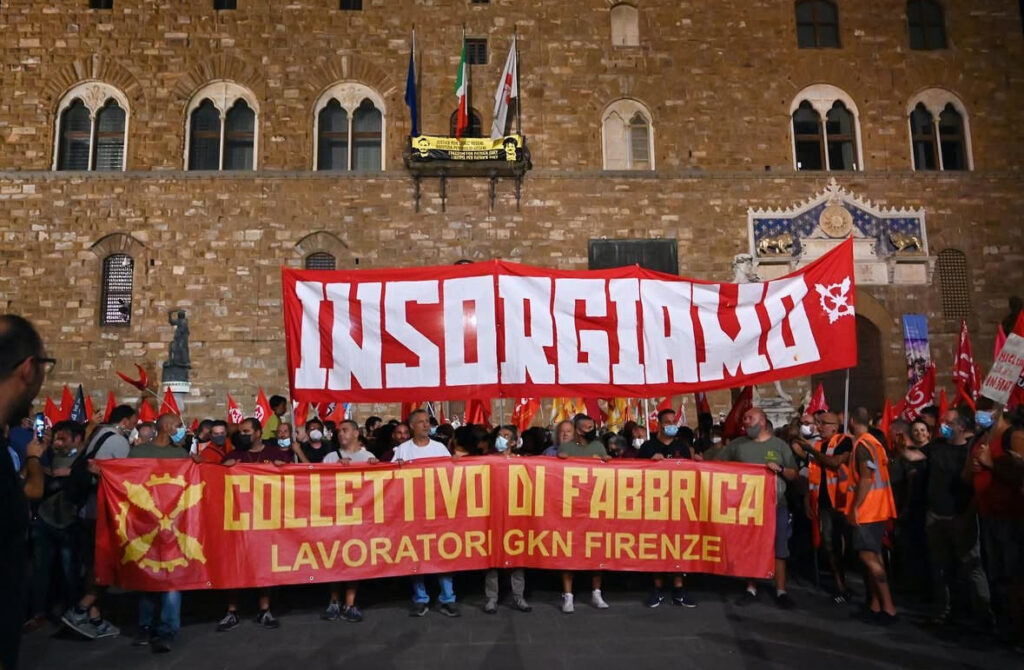
The longest workers’ struggle began on July 9, 2021, when Melrose announced in an email that it would close the plant and initiate redundancy procedures. That day, all 422 workers, most of whom had worked in the factory for more than a decade, were put on collective leave. Within half an hour, more than 100 workers had entered the factory and declared themselves in “permanent assembly”.
The goal of the permanent assembly was to collectively find solutions to save the factory. “We had no will to stop the production,” said Salvetti, spokesperson for the workers’ collective. “We have put our bodies into the factory to call the production back, shift after shift – every day. Our bodies were the only factors able to stop the delocalization, not the laws or the government.”
After four years of mobilization, the EX-GKN collective has created a network of support ranging from ordinary citizens to Italian and international associations. Three dismissal procedures and changes of ownership of the factory, in a long and exhausting struggle, has led to change: the approval of a regional law protecting the consortia. This means that municipalities and public institutions are able to join forces to take over factory sites and ensure that work and production continue, instead of the sites being sold or decommissioned.
Sold for Parts
When British investment company Melrose Industries initiated the closure of the factory, it followed the ‘buy, improve, sell’ strategy, whereby companies are bought, restructured and then sold off for parts. In the case of the GKN factory, the plan was to relocate production to countries with lower labour costs, such as Poland – even though the plant was economically successful and sales had actually increased in the first quarter of 2021. According to reporting by IrpiMedia, Melrose Industries had been secretly preparing to close the plant since the beginning of 2020 – even while the opposite was communicated to employees and trade unions. When asked why the company wanted to close the plant despite increasing profits, GKN Automotive did not respond to our interview requests.
On April 1, 2025, former employees received letters stating that their employment contracts would be permanently terminated, because GKN was being liquidated. On June 25, 2025 the Court of Florence ordered the eviction of the former GKN factory in Campi Bisenzio, ordering its occupants to leave the property. When the eviction is executed, it could mark the official end of a factory that had been worker-occupied since July 2021. But before this could happen, the factory in Campi Bisenzio had undergone a fundamental transformation. A production site became a permanent place of resistance, organized by workers. In the midst of the emptiness, a new project emerged, an attempt to think about labour in a radically different way.
The question of what to produce
During the permanent assembly, the collective planned not just to manage production, but to rethink what to produce and how to organize the factory. They initially discussed whether they wanted to continue manufacturing car parts – and decided against it. Instead, they agreed to produce solar panels and cargo bikes – a plan they considered both economically viable and in line with their ecological and social values.
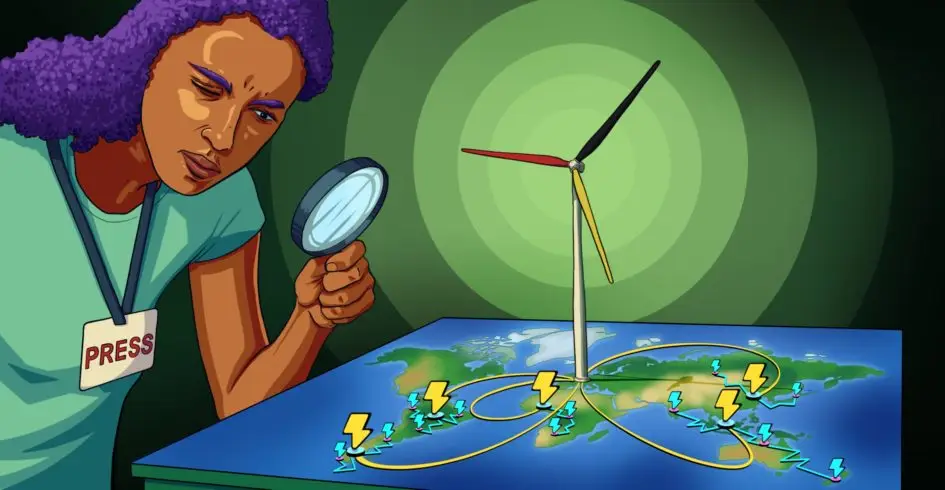
Economically, the group aimed to preserve local jobs and avoid the foreign supply chains and outsourcing that had led to the factory’s shutdown in the first place. The manufacturing of solar panels was considered a possible avenue to restart manufacturing that would sustainably benefit the community in the long run, rather than simply maximize profit. By giving priority to renewable energy technologies, they could align their local workers’ struggle with the needs of the climate crisis.
The reindustrialisation plans
In November 2021, the Collective founded a working group on reindustrialisation to plan the restructuring of the factory’s production and convert it to an ecological approach. The group was made up of workers, scientists and researchers from the Sant’Anna School of Advanced Studies in Pisa and the University of Florence, as well as other institutions. Together, they worked out concrete plans for an ecologically sustainable and collectively-operated factory, paying attention to its supply chains and financing. “One point is to have knowledge and another one is to understand how to translate the shared knowledge into a common instrument of struggle,” said Leonard Mazzone, researcher at the Department of Social and Political Sciences of the University of Florence and part of the reindustrialization group since October 2022.
The first plan of the reindustrialisation group aimed to maintain production at the former GKN plant in cooperation with public institutions. “When you write a project, you also have to face the silence and the institutional absenteeism of the institution and the ownership,” said Mazzone. The reindustrialization group adjusted its plans to the challenging circumstances, leveraging workers’ expertise and partnering with an Italian-German company with new photovoltaic technology. Soon, they discovered the technology was not ready for industrial use. As a result, they shifted their focus to plans for producing customized photovoltaic modules, including a recycling process.
This plan would secure 99 jobs: 46 in the production of photovoltaic panels, 17 in installation, 26 in the recovery of panels and a further ten jobs in the production of cargo bikes.
The socially integrated factor
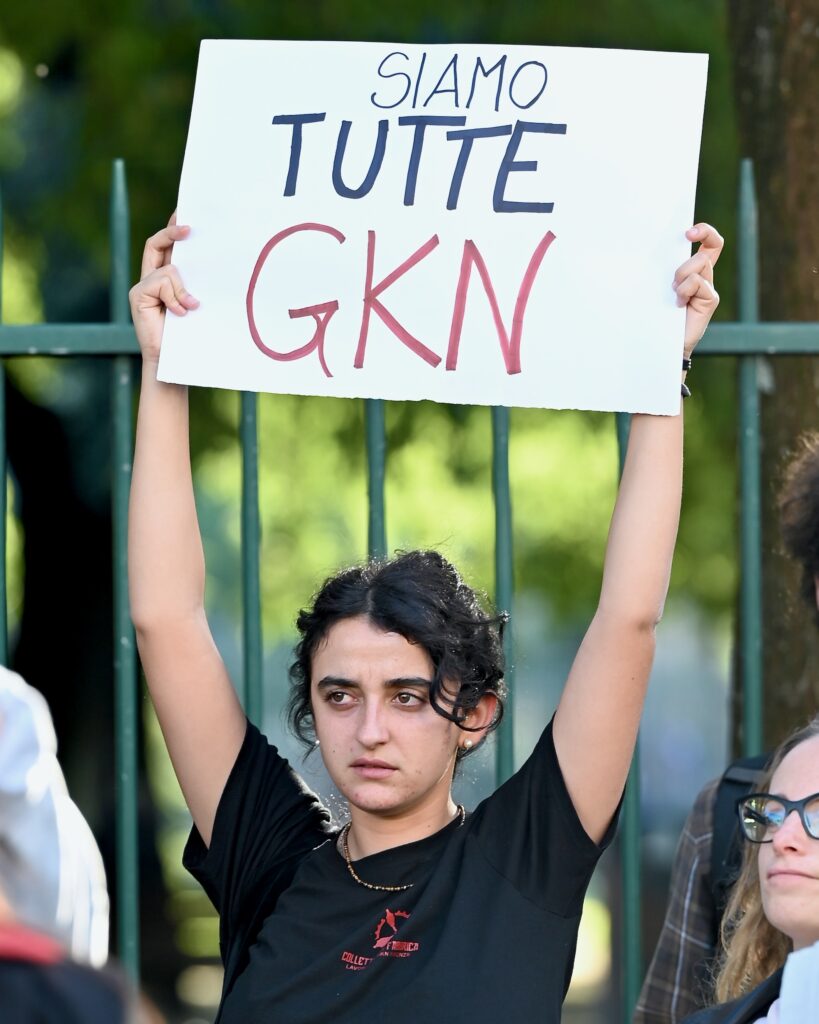
"It is already difficult enough to keep a job, but what is the point if, in doing so, we risk our lives due to polluted air, extreme climate events or global crises, whether from environmental collapse or a new war?”
Dario Salvetti
The reindustrialization plan is part of an idea called the `Social Integrated Factory,’ which offers an alternative to both traditional capitalist industrialisation and profit-oriented production. “We have developed a model of an integrated social factory, a mix of intervention from the bottom and from the top, from the Tuscany Regional Council to popular support,” explained Salvetti.
This model takes into account the threat of the climate crisis, he argues. “At the dawn of the working-class struggle, there was no distinction between the economic struggle and the struggle for life. We fight for wages and a workplace, not just for money, but for the right to live. The original aspiration of the working-class movement was to address every issue both inside and outside the workplace. It is already difficult enough to keep a job, but what is the point if, in doing so, we risk our lives due to polluted air, extreme climate events or global crises, whether from environmental collapse or a new war?”
According to social movement expert Guadagnucci, under a traditional capitalist system, the decision of what to produce is usually made in an opaque manner, by whoever is in charge at the moment, be that an entrepreneur or investor. “But it doesn’t necessarily have to be that way. We are also seeing the disasters that this [capitalist] model has produced.”
The GKN collective’s experience shows that another way of working exists. “In almost four years, we have seen that the vertical structure – that is typical of the traditional organization of work in the factory – was completely useless and harmful for the workers,” said Salvetti.
The solidarity network
By the time they were formally dismissed on April 1, 2025, the workers had already been without wages for over a year, since January 1, 2024, after the expiration of a redundancy fund. Some had previously endured an even longer gap: no pay between October 2022 and July 2023.
“We couldn’t last so long without the support network,” said Snupo, a member of the workers’ collective. “The difference in our struggle was born from the question, ‘E tu come stai?” [“How are you?”]
“We were left in a limbo used against us,” continued Salvetti. The factory owner was absent regarding any decision and unpaid wages. The regional institutions were paralyzed by bureaucracy. Still, the collective did not stop.
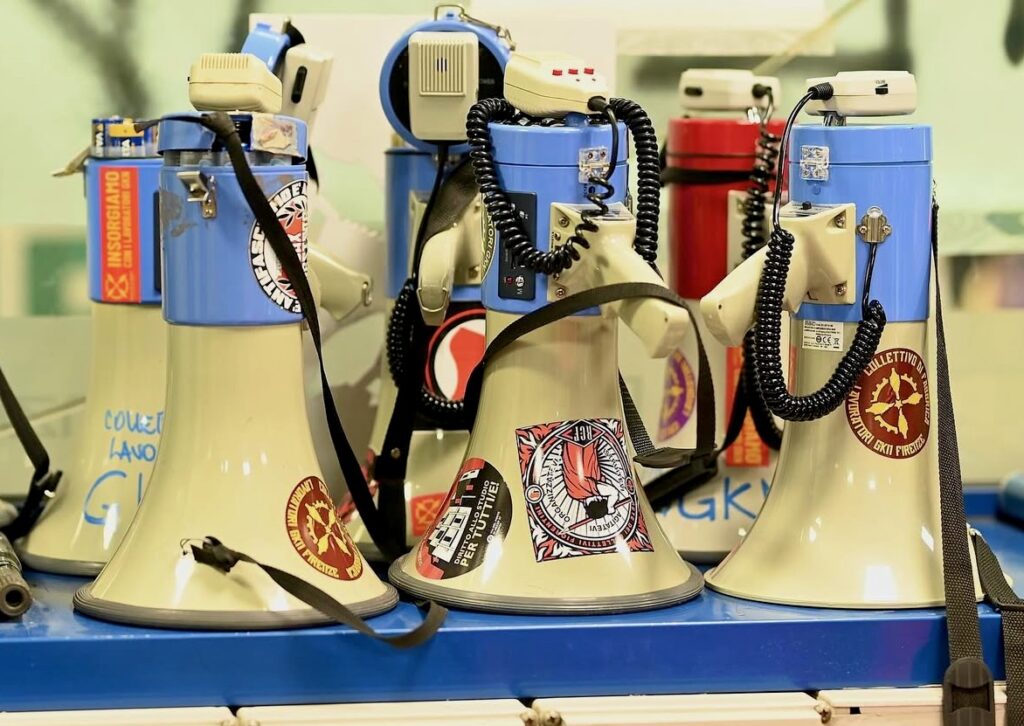
“This was a kind of war of position, waiting for an enemy that never came”, said Salvetti. Of the 380 original workers, today approximately 120 remain in the collective’s workforce. “The economic situation is very difficult for all of us. I survived, like others, thanks to savings during this year without salaries and subsidies,” explained Alessandro Tapinassi, 60, who has worked in the factory since 1987 and is part of the musical brigade that plays percussion at all the demonstrations.
“We were lucky to pay our mortgage off just before July 2021 and I continue my job as a bartender,” added Letizia Verdi. “My husband suffers from multiple sclerosis, and the factory’s sudden dismissal has made his health situation worse, but he has never given up a day. We have embraced this struggle, we have warned our 20 and 16-year-old children that it will be complicated, and we will have to give up little things. I wanted to make them understand that life is beautiful but also very difficult, and we have to face difficulties with a smile.”
After the dismissal, many workers urgently needed to find new opportunities to support their families. “A lot of colleagues left [the collective] due to economic reasons, others are still there but are not coming to the factory; they are suffering once they visit it,” continued Tapinassi.
Those who remained in the collective have had to find resources to keep their fight going. One way they were able to do this was with the Working Class Literature Festival, organized every year outside the factory: three days of books, culture, and music dedicated to building a shared cultural imaginary of the working class struggle.
Seven thousand people participated in April 2025, arriving from all over Italy and Europe. “The risk was that, after three and a half years of struggle, the layoffs would fall into invisibility. The festival turned another spotlight on the dispute and brought the solidarity community back to the streets, to demand the factory be public and socially integrated,” the collective said.
Through crowdfunding they were also able to raise two million euros – start-up capital to take over the factory themselves as a workers’ cooperative. The campaigns involved crowdfunding via online donation platforms as well as the Insorgiamo tour through various cities in Italy and Germany, where the collective shared their plans, collected donations and invited supporters to invest directly in the industrial project.
But all interviewees contacted for this report agree that what has kept them going since the beginning has been a groundswell of public support. “The collective is supported by a solidarity group composed of people from 12 to 90 years old, from different backgrounds… from Fridays for Future, people against the new airport, to other local groups,” explained Flavia Brunetti of “Studenti di Sinistra”, a university collective that supported the workers’ movement. “Like many students, many people, we are disappointed by political parties and unions. So we decided to support this fight because it involves a lot of topics such as environment, worker rights, and social justice.”
The most successful strategy to gain public support was to broaden the field. The struggle of the ex-GKN collective is more than a union struggle; it’s also an ideological and popular struggle over the basic organization of society, as Guadagnucci highlighted. “This story can become exemplary and make people understand that there is still room for discussion, even on the most fundamental terrain of how a society is organized, how it works, why it works, what is produced, how it is produced, and how much is produced.”
The solidarity received from the community was also reciprocated. During flooding of the plain between Florence and Prato in November 2023, which killed two people and displaced 200, the factory became a mutual aid center.
Building a blueprint
“With this law, the Region of Tuscany has equipped itself with an active industrial policy tool, capable of intervening even in complex and extraordinary situations."
Gianni Anselmi
Despite dedicated workers and broad public support from many sectors, the GKN collective realised that they would not be able to implement their idea without a legal basis – much less turn it into a blueprint that others could follow. What they needed was a legal framework that would allow them to take over former industrial sites, redevelop and organise them democratically, for example, in cooperation with regional institutions of Tuscany. Based on this idea, they developed the Regional Law on industrial consortium.
The Regional law would enable regional authorities to set up public industrial consortia to take over industrial crisis sites, secure the existing machinery and buildings on site, and turn them into new production sites, as in the reindustrialization plans for Campi Bisenzio. The law requires the consortia to consist of at least 51% public actors, such as municipalities, universities and labour cooperatives.
In order to get the law onto the political agenda, the collective built up years of public pressure: they organised demonstrations, from the first protest in Florence on Sept. 18, 2021, when 20,000 people marched to demand the withdrawal of dismissal proceedings, occupied Florence’s city hall, carried out a 13-day hunger strike and protested directly in front of the Tuscany Regional Council. Many workers participated in this tireless activism even as wages dried up after the exhaustion of redundancy funds.
After months of debate in a four-day marathon session and despite over 300 amendments proposed by the right-wing Lega party, the Regional Law was passed in December 2024.
“We collected and enhanced the experiences and needs of other Tuscan entities that are moving in the same direction,” said the President of the Economic Development Committee in the Tuscan Regional Council, Gianni Anselmi. “With this law, the Region of Tuscany has equipped itself with an active industrial policy tool, capable of intervening even in complex and extraordinary situations,” he continued.
The Regional law is an important political win, but its implementation for EX-GKN remains delayed due to bureaucratic inertia and unresolved legal issues with the factory site’s current owner (Tuscany Industry Srl and Sviluppo Toscana srl). GKN still owes approximately 18 million euros in liabilities – mostly to employees, between back wages and severance pay.
“We ask the regional council to put in practice the regional law to buy or to expropriate the factory. When the area becomes a public area we will build it up according to our reindustrialization plan, with the support of a popular campaign,” said Salvetti.
For the EX-GKN Collective, every day without a signed agreement, without keys handed over, without the consortium becoming real, is an exhausting wait. They have demonstrated, negotiated and rewritten laws. Though the founding documents and statutes for the public consortium are prepared, everything is pending.
Another world is possible
"We have been told for decades that there was no other way to organize society. This was an idea supported and repeated only by those who have power and tools to make you believe it. Now someone tells us this is not true."
Lorenzo Guadagnucci
While the project is still in progress, the collective is already creating a radical change in the labor and class struggle by proposing that communities control production, rather than corporations. They are also questioning current legislation and supplementing it in terms of social communities.
“We are all immersed in a kind of depressing ideological context,” continued Guadagnucci. “We have been told for decades that there was no other way to organize society. This was an idea supported and repeated only by those who have power and tools to make you believe it. Now someone tells us this is not true,” he concluded.
The collective managed to pass an unique law in Italy that make workers´consortiums possible in disused industrial areas, such as in the Florentine plain, and created a popular movement.
“Social movements usually emerge differently,” Guadagnucci concluded. “Because they emerge from more popular struggles, while workers’ struggles usually remain a limited union or political issue. This case, however, is more like a social movement, and I think the possibilities for real change lie in social movements.”
After four years of struggle, the collective doesn’t want to give up: “We have been right so far, we must continue to have the strength to move forward,” they affirmed.
About the authors
Noa Jaari is a German freelance journalist based in Berlin. She writes about social issues such as grassroots movements, educational justice, social inequalities, labour and production conditions.
Monica Pelliccia is an Italian freelance multimedia journalist based in Florence who covers environmental and social issues such as biodiversity conservation, women’s issues, climate change, Indigenous Peoples’ rights, food security and agroecology. She has produced reports from India, Costa Rica, Guatemala, Honduras, Brazil, Cambodia, Morocco, and Palestine for Mongabay, The Guardian, El País and other international media outlets.