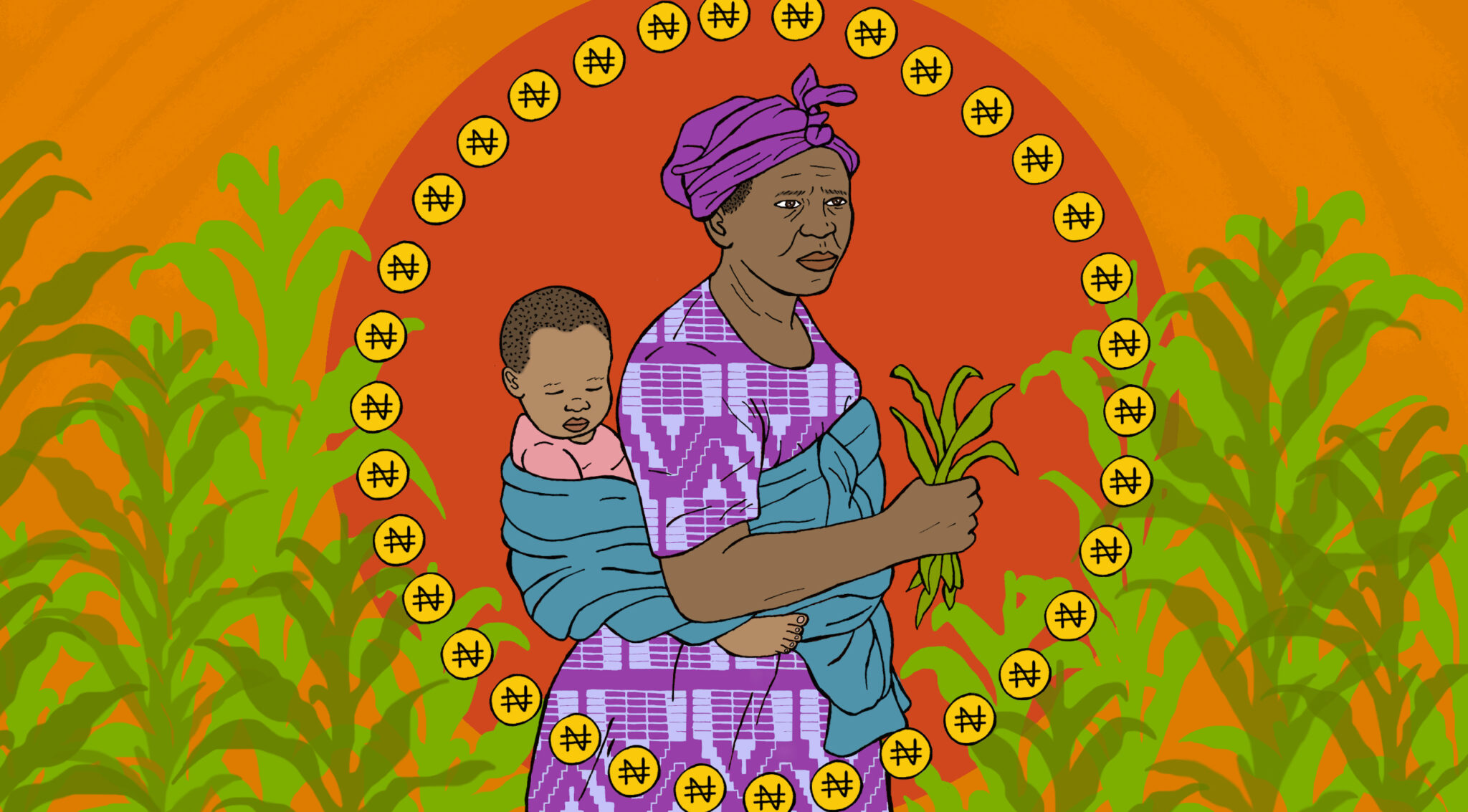


The midday sun bears down on Piyanko, a farming community in Nigeria’s north-central state of Nasarawa, but Asabe Garba does not pause to rest. At 34, the lines on her face are deeper than her years, shaped by the combined demands of farming and motherhood. She is the second wife of Mallam Abdul Garba, a local government official whose monthly salary of 95,000 naira ($66) rarely covers the family’s needs. School fees, food, clothing and hospital bills compete for attention as soon as the money arrives.
Asabe has five children. Her youngest is eight months old, still strapped to her back as she works in the fields. Her eldest, a 15-year-old boy, helps with planting and harvesting. She was also 15 when she left school, her education cut short by poverty and the belief that her future lay in the fields rather than the classroom. Farming was not simply her inheritance; it was her obligation.
For years, Asabe relied on a community credit union to fund her farming. Members pooled resources and borrowed up to 50,000 naira ($35) at five percent interest – just enough for seed and fertiliser. The arrangement was modest but manageable, providing a thin buffer against uncertainty. Still, Asabe wanted more: more land, better yields and relief from the pressure on her husband’s modest income.
That opportunity appeared in 2022, when she approached the Lift Above Poverty Organisation (LAPO), one of Nigeria’s largest microfinance banks, with more than 500 branches nationwide. LAPO describes itself as providing “tailored financial solutions for low-income households and small businesses, bridging financial gaps and creating opportunity.”
To Asabe, the language translated into hope. She secured a loan of 300,000 naira ($210). With it, she leased two hectares of farmland, bought seedlings and tools, and hired two women to help with labour. That season was transformative. She repaid the loan within six months, earned new respect in her community and even contributed to completing part of her family’s house. For the first time, farming felt like a route to stability rather than mere survival.
“I thought maybe my life was changing,” she said. “I thought this is how my children would not suffer like I did.”
What followed was not simply the unpredictability of farming. It was the collision of climate change with a lending system that increasingly shifts risk onto borrowers reliant on rain-fed agriculture. As weather patterns grow more erratic, short-term microfinance loans have become high-stakes bets. When crops fail, the losses are borne not by banks or the state, but by women like Asabe – turning credit meant to empower into a pathway to deeper vulnerability.
Floods, debt and the poverty trap
Last year, Asabe took another loan of 100,000 naira on a three-month cycle. That year, the rains were heavier than expected. By August, her maize and melon fields were submerged. When repayments fell due, she had nothing.
After several unsuccessful attempts to reach her by phone, LAPO officials visited her home and seized her 32-inch television—the only luxury item she had ever bought with farming income.
“I cried that day,” she said. “Not because of the television, but because I knew it was the beginning of a debt I could not escape.”
She returned to her cooperative, borrowing 50,000 naira. Friends and relatives contributed what they could. She eventually settled the loan, but the cycle tightened. In February this year, she borrowed another 200,000 naira from a different LAPO branch on the outskirts of Abuja. She cleared old debts, bought fertiliser and planted again. The floods returned. Another season was lost.
“It feels like I am farming for the banks, not for my children."
Asabe Garba
Across Nasarawa, similar stories recur.
In Uke, farmer Ruth Baba borrowed 250,000 naira ($170) to expand her maize farm. A sudden dry spell halved her yields. To repay the bank, she sold two goats she had been saving for her daughter’s wedding. “I felt like I was selling my dignity,” she said.
In Masaka, Esther Lukas, a young widow, borrowed 150,000 naira to plant cassava. Drought destroyed her crop. To repay, she sold her late husband’s motorcycle – her only asset and means of transport. “Now I walk to the farm every day,” she said. “At least walking is free.”
In Mararaba, women described forming informal “debt circles,” contributing small amounts to help one another avoid default. But when one farm fails, the burden spreads quickly. A single flood can pull several families into debt.
The humiliation of repossession deepens the damage. In Piyanko, neighbours whispered for days after Asabe’s television was taken. In small communities, reputation is as vital as seed. Once a woman is marked as indebted, she loses not only property but dignity.
Despite everything, Asabe is already considering another loan. Not out of ambition, but necessity. “It feels like I am farming for the banks, not for my children,” she said.
Climate shocks, fragile credit
Older farmers in Nasarawa recall a time when rainfall followed a predictable rhythm. That certainty has vanished. The Nigeria Meteorological Agency has warned that climate change is disrupting rainfall patterns, bringing delayed onsets, shorter wet seasons and more intense storms.
In 2024, floods destroyed an estimated 25,000 hectares of farmland in Nasarawa. Nationwide, more than 1.5 million hectares were affected, displacing over 1.2 million people.
For farmers like Asabe, climate shocks mean not only hunger, but debt. Microfinance banks provide credit where commercial banks will not, but often with little flexibility when disaster strikes.
LAPO says it assesses risks before approving agriculture-related loans. A LAPO employee who asked not be named said flood-prone farms are often rejected. “That is why many borrowers claim the money is for trading,” he said. “When disaster comes, they admit it was farming. By then, it is too late.”
Asabe acknowledges concealing the true purpose of her loan. “If I said it was for farming, they would not give it to me,” she said.
Microfinance banks provide credit where commercial banks will not, but often with little flexibility when disaster strikes.
The fragile promise of microfinance
Microfinance was once celebrated globally as a breakthrough idea. In 2006, the Nobel Peace Prize was awarded to Muhammad Yunus and the Grameen Bank for pioneering small loans as a tool to lift women out of poverty.
But the experiences of women farmers in Nasarawa raise questions about how that model performs in contexts marked by climate volatility and deep social stigma around default.
The Central Bank of Nigeria has reported rising loan-repayment risks among microfinance institutions, driven largely by floods and droughts. Debt recovery consultant Abutu Ujah said the sector has drifted from its original promise.
“Loan officers rarely offer grace periods or climate insurance,” he said. “Collateral substitutes—televisions, grinding machines, motorcycles—are quickly seized. For women, the system often reinforces inequality rather than reducing it.”
Women account for more than 70 percent of Nigeria’s agricultural labour force but control less than 20 percent of farmland and receive under 30 percent of agricultural credit.
Despite these challenges, farmers like Asabe keep borrowing. Without her farm, her children would go hungry. Farming is both her lifeline and her trap.
Her greatest fear is that the bank will return for her grinding machine—the last buffer against destruction.
Across Nigeria, climate change is eroding not only crops and soil, but the promise of farming as a dignified livelihood.
For Asabe, the question is no longer whether she will borrow again, but whether she will ever be free.
About the author:
Goodness Chibunna is a Nigerian journalist and editor covering climate change, political economy and accountability. Her reporting focuses on how financial systems, public policy and environmental shocks intersect to shape the lives of Africans, particularly women. She works across long-form reporting and multimedia storytelling.
What are ultramarins? How many colonies does France have? Do people in French territories have French citizenship or nationality?