

There was once a dairy hand in Zewan who lost a cow each day. Every evening his master scolded him for letting one of the herd wander off into the woods and returning with too little milk,” Haji Anwar Bhat begins, recounting a story passed down through generations of saffron farmers.
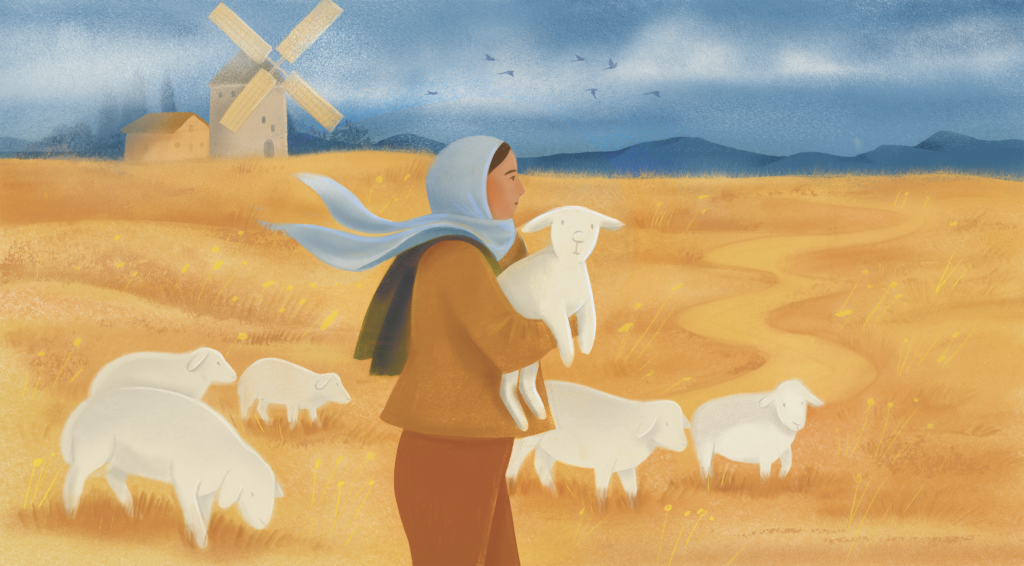
One day, the dairy hand followed a wayward cow and found her suckling four snakes. Gathering his courage, he lunged to catch them. Two escaped into the spring of Zewan. But the two he caught hold of transformed before his eyes into princes. Overcoming his shock, he demanded the princes compensate him for the stolen milk. ‘We will give you a gift that will always be remembered,’ they told him.
From the water of the spring surfaced a clay bowl containing a blooming flower and luminous threads of golden saffron. Confused, the dairy hand asked what he was supposed to do with it. The princes instructed him to take it to Khawaja Masood Wali, a Sufi saint in Pampore. ‘Dig a patch of land and bury it,’ the saint told him. The arid earth of Pampore bloomed with what remains the world’s most expensive spice. “From that point on, our ancestors began cultivating saffron in the area. Some produced more, some less, but nearly every household had a part in this tradition,” Haji Anwar says.
From growing the flowers and the delicate work of separating their tiny red-gold stigmas, to packing and marketing, the saffron industry provides a livelihood for some 30,000 families, or about five percent of the rural workforce across Kashmir. But owing to its particular soil and micro-climatic conditions, Pampore’s saffron has a high crocin content, which lends it its rich color and its medicinal value, making it particularly prized.
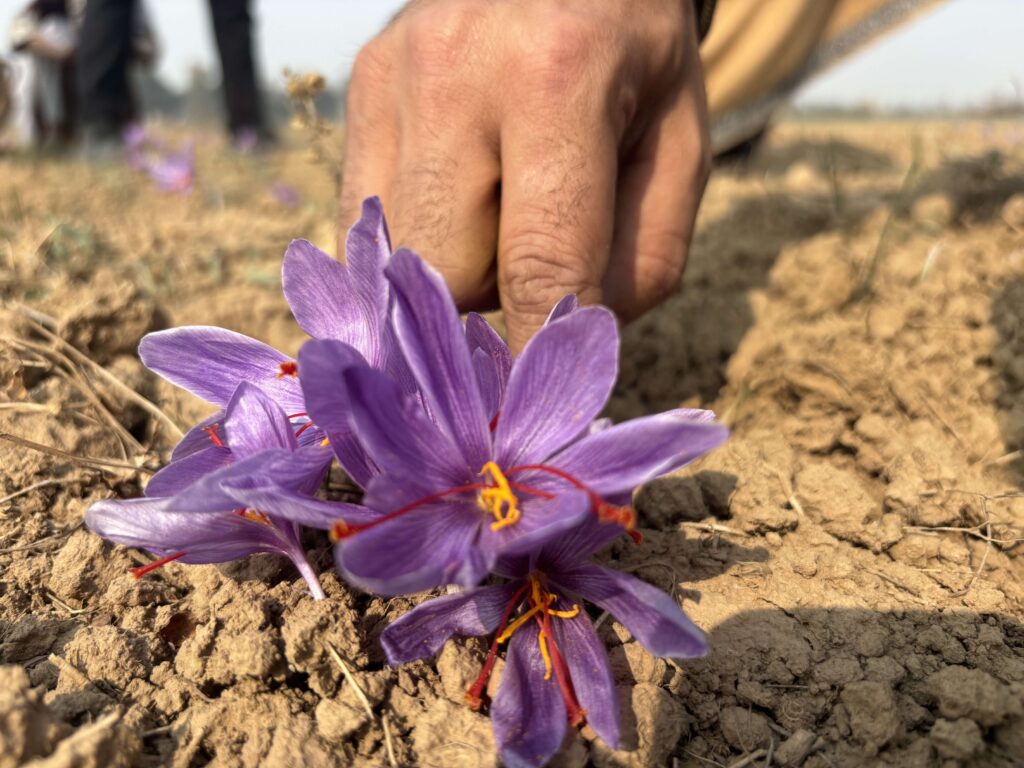
Saffron crocuses bloom in autumn, covering Papmore’s Karewas – the elevated plateaus around the town where saffron is grown – in an expanse of purple flowers. When harvesting begins, the first tola (about 12 grams) of saffron is given as a sacred offering to Khawaja Masood Wali at the saint’s shrine.
Yet over recent years, environment pressures have put Pamopre’s precious gift under pressure and traditional practices are changing in a struggle to adapt. “In earlier times, we would go to the fields at dawn and return only at dusk,” Haji Anwar says. “We cared for our land with our own hands. I have 100 acres of land where we used to harvest ten tolas of saffron. Now, we barely get four tolas.”
Modern threats to ancient tradition
Kashmir has witnessed huge deforestation over the last few decades, exacerbating drought and soil erosion. At the same time, saffron fields are under threat from construction. “The environmental changes through global warming, erratic weather patterns and unseasonal rain have affected the crop in Pampore and other saffron-growing areas. Another significant reason is the dust pollution caused by cement plants,” Faiz Bakshi, convenor of the think-tank Environmental Policy Group in Kashmir, explains.
Pampore’s main saffron fields are located beside the national highway, along which thousands of passenger and freight vehicles pass every day. Cement dust containing harmful gases like carbon monoxide settles on the flowers. And large areas of saffron fields have been converted into commercial and residential colonies. “The classic example is that of ‘Saffron Colony’ – the name itself explains it all. Sadly, there is no regulation or strict implementation of land use laws in force,” Faiz says.
A senior government official who requested anonymity told Unbias that erratic weather and water stress had reduced the area where saffron is cultivated in Pampore from 5,707 hectares in the 1990s to around 3,700 hectares today. It’s a vicious cycle: as the saffron fields retreat, the fragile landscape of the Karewas becomes ever-more exposed and vulnerable to erosion. When the exposed land is abandoned by farmers, haphazard construction takes over.
The Indian government has not been oblivious to the decline of a crop so culturally and economically important to Kashmir. In 2010, it launched the National Mission on Saffron with a total outlay of over 400 crores (about 40 million euros) aiming to rejuvenate 3,715 hectares of saffron land. Fifteen years later, the government insists that that the Saffron Mission has been a huge success. But data points to a continued decline, and farmers say they have seen little impact from the investment.
Parched lands and mismanaged water supplies
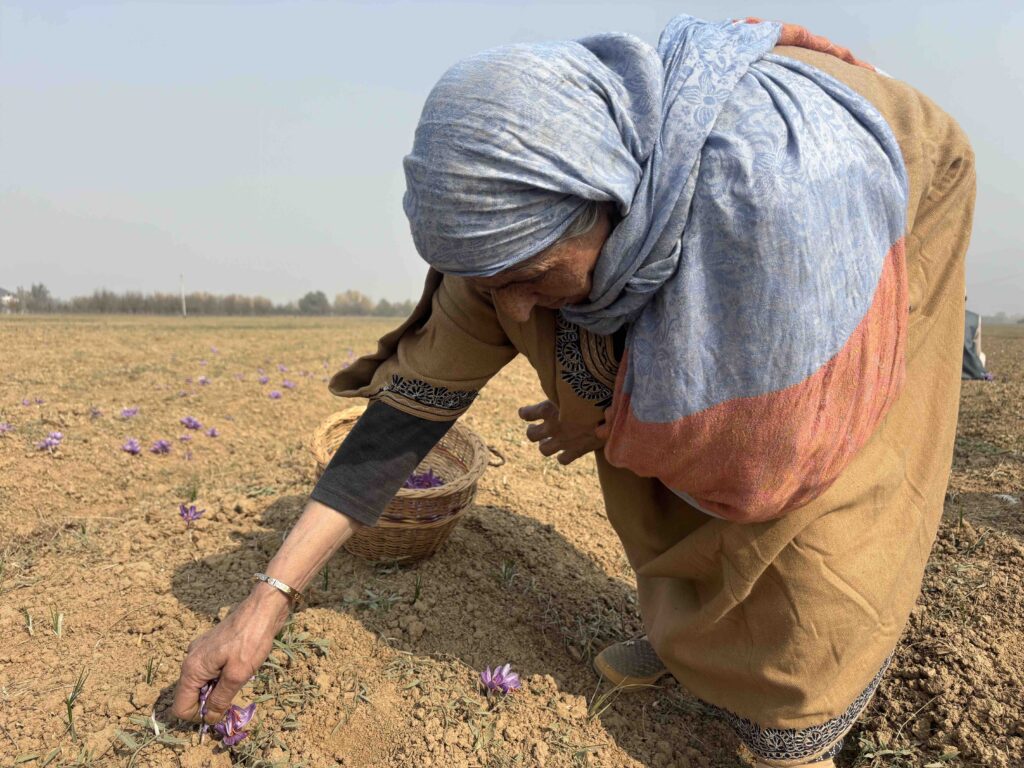
From August to October, heatwaves wreak havoc on the crop, which is particularly dependent on rainfall during that time. Kashmir is experiencing an alarming rainfall deficit, having received 29 percent less than normal in 2024, and saffron production hit an all-time low.
The agriculture department has built borewells to irrigate saffron fields. But farmers say what they need are sprinklers that disperse fine droplets to mimic natural rainfall. Saffron cannot be watered manually or in bulk. It is highly sensitive to the method and timing of irrigation. “We can’t just water it like an ordinary crop – it must be sprinkled. If water falls directly on the flowers, it will damage the entire crop,” says saffron farmer Ghulam Ahmad Khan.
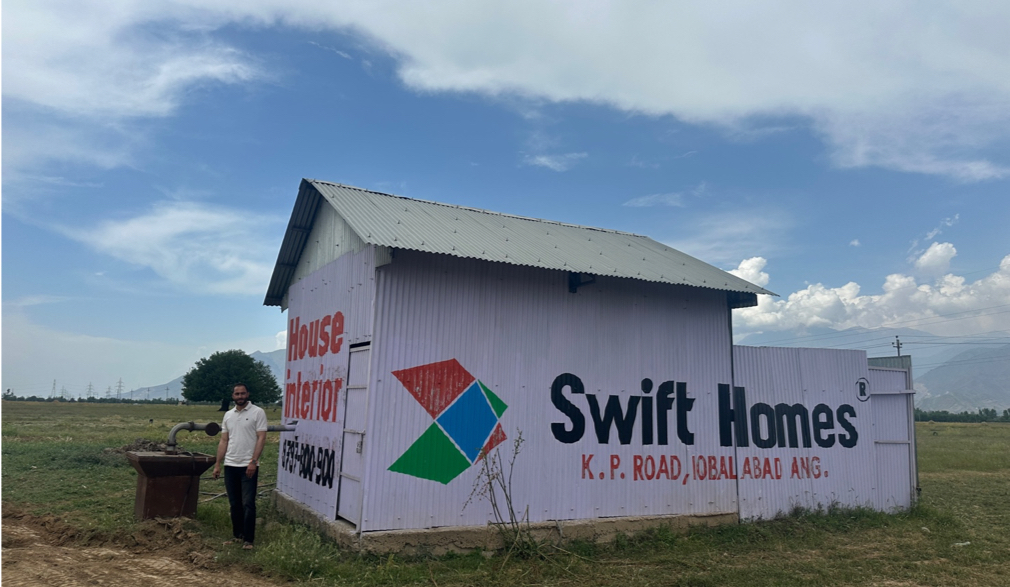
Farmers say borewells built by the government aren’t working, and there has been confusion over who is responsible for operating and maintaining them. Farmers wanted the government to take care of maintenance and for the Public Health Engineering department to take responsibility for actively sprinkling the fields during dry spells and extreme heat.
“The government has constructed irrigation wells; there is no doubt about that,” Ghulam Ahmad says. “But the land on which these wells are built belongs to private owners who demand money. There is also the cost of hiring someone to operate the system. No one is willing or able to bear these expenses, so the wells remain shut and unusable.”
Mohammad Abdullah Bhat, a farmer with 40 kanals (about 2 hectares) of land, says that borewells have been damaged and pipes stolen. “People looted whatever they could and left behind nothing but broken structures,” he says. “Millions have been spent on this so-called National Mission on Saffron. But there’s no accountability, no supervision, no one on the ground to make sure things work. The entire pipeline laid underground has disappeared. Isn’t this gross negligence?”
“Millions have been spent on this so-called National Mission on Saffron. But there’s no accountability, no supervision, no one on the ground to make sure things work. The entire pipeline laid underground has disappeared. Isn’t this gross negligence?”
Mohammad Abdullah Bhat, farmer
Tensions between science and experience
Syed Altaf Aijaz Andrabi was director of agriculture for the state government from 2015 to 2020, during which time he worked to boost production by promoting science-based planting techniques and mechanized farming, to improve soil health and improve irrigation.
Farmers were “advised to increase crop density for better yields and taught the correct depth for sowing corms,” he says. Traditionally, Syed explains, farmers sowed corms so deep, it would take two years for the flowers to bloom. Shallower planting should mean quicker growth, and so more frequent harvests.
“The government needs to stop viewing farmers as illiterates. Instead, they should listen to their advice, as these farmers have been associated with saffron cultivation for decades.”
Wahid Bhat, farmer
But Pampore’s farmers haven’t always taken kindly to outside experts instructing them on how to manage their heritage. Irshad Ahmad gets 100 grams of saffron per kanal from land where his father used to harvest three times that. He says the agriculture department instructed farmers to sow only larger corms – those weighing 8 grams or more. “What are we supposed to do with the other corms?”
“This is not a seed-based crop where we can just store seeds and reuse them. Saffron is a rare crop in which a mother corm gives birth to daughter corms and then it dies. Eventually, the daughters give us the saffron,” Irshad explains.
Deforestation has also impacted local wildlife, with knock-on effects on saffron production. Farmers say they must bury their corms deep to evade porcupines that have lost their natural habitat and burrow into their soil in search of food. They also asked for the government’s help to eradicate them but were refused on the basis that porcupines are protected under conservation regulations.
“The government needs to stop viewing farmers as illiterates. Instead, they should listen to their advice, as these farmers have been associated with saffron cultivation for decades,” says farmer Wahid Bhat.
Sins against God and nature
The story of the serpent-princes and the dairy hand isn’t the only origin story behind the saffron of Pampore. Historian Zareef Ahmad Zareef says saffron may have been brought to Kashmir by merchants from China. But Sufi legends have a powerful hold in Pampore, where folklore is woven into the texture of life. According to another tale, saint Khawaja Masood Wali gave Pampore its first crocus bulbs in thanks to a local healer who revived his student, Sheikh Sharif-u-Din Wali – another locally revered saint.
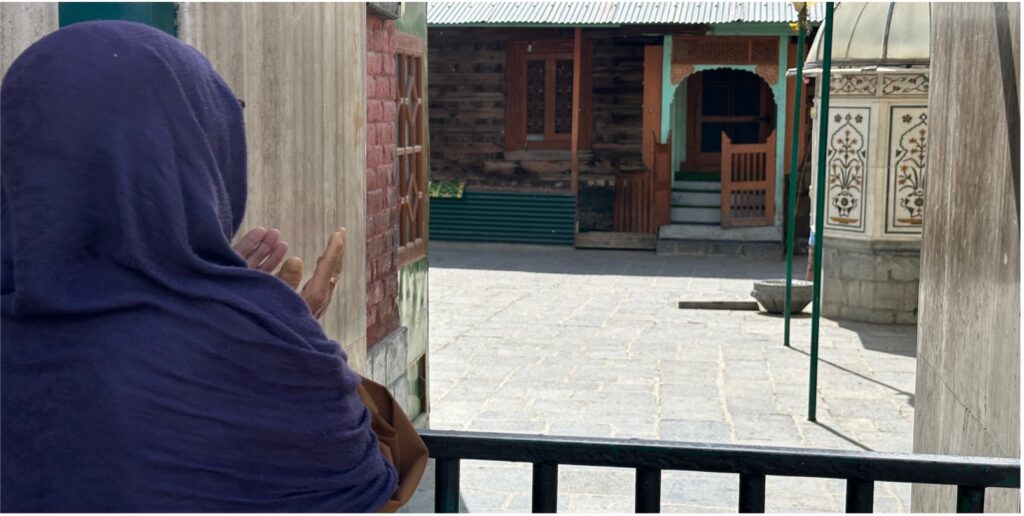
At the shrine to Khawaja Masood Wali in Pampore, an officiant blesses a pail of water for Ghulam Mohammad Bhat, a local farmer who will take the water back to his fields and sprinkle them over his crop. Ghulam Mohammad’s land spans 70 kanals. “When my father was alive, he would harvest twice as much saffron as we do now, and on a smaller piece of land. Now climate change, lack of water and our own sins have led to the decline of this magical crop,” he laments.
Ghulam Mohammad says fewer young people are interested in farming these days, and some are selling their land saffron fields to property developers, or “land mafia” as he calls them – a sin of greed that disrespects Pampore’s divine gift and leaves its future in the hands of migrant laborers from other states.
Syed says some farmers take a similar view of agrochemicals. “People were not using fertilizers or other supplements on saffron land because they believed it was God’s land and that God would protect it himself. My colleagues and I worked hard to convince them to adopt modern methods. But it was incredibly difficult to change their mindset,” he says.
Yet Syed also admits mistakes. One of the Saffron Mission’s first initiatives was to provide farmers with ₹25,000 [234 euros] for every kanal of land they farmed, to pay laborers when “we should have prioritized irrigation,” he says.
Despite the challenges, saffron remains one of Kashmir’s most valuable crops, generating over 500 crores – about 50 million euros – annually and providing substantial seasonal employment. And farmers are not universally resistant to adapting ancient practices to modern conditions. “If the government focuses on sharing this knowledge with farmers,” Ghulam Ahmad Khan says, “saffron cultivation could still be revived.”
If the government could do regular consultations with farmers to make the crop climate resilient and the production higher, if ancestral ways of saffron farming could be respected and integrated with scientific methods the farmers find useful, it could save a precious crop that is as central to Kashmir’s culture as it is to its economy.
About the author:
Sadaf Shabir is a multimedia journalist based in Kashmir reporting on gender, environment, education and conflict. Her work has featured in leading national and international publications.
What are ultramarins? How many colonies does France have? Do people in French territories have French citizenship or nationality?