

Alarm bells have been going off for some time, but they have now reached a fever pitch.
News articles that once tentatively posed the question, “Is democracy at risk in [insert any country all over world]?” have now been replaced with declarative statements. Democracy is in peril. Democracy dies in the darkness. Democracy is in decline.
Whether the threat to democracy stems from MAGA stans and their bombastic red-capped leader in the US, the movement around the tea-seller’s son in India, or eccentrically coiffed populists in the Netherlands, Argentina and the UK, a wave of leaders indifferent to human rights, international law and climate change have ridden a wave of democracy-skepticism to power the world over.
In countries where democracy was already corrupted or nonexistent, the latest wave ensures even fewer consequences for rights violations and atrocities – against their own populations, or those of neighboring countries. In Africa, faith in democracy has declined, and the decade has already seen more coups than the 1960s. Wars in Europe, Africa and the Middle East flaunt a shocking indifference to post-WW2 international legal protections for civilians, leading to daily accusations of the most egregious war crimes. The worse it gets, the more authoritarian governments seem to provide cover for the others, or grant a “whataboutist” excuse for inaction. And as the media, we seem to have no choice but to document the decline.
Nevertheless, journalists have identified patterns of behavior that seem to repeat in every instance where these movements have reared their heads. You could call these patterns “the authoritarian playbook”. They include demonizing immigrants, women or minorities; censoring, suing or buying up the free press; dismantling regulations protecting the climate and workers’ rights; and importantly, undermining democratic institutions such as an independent judiciary or free and fair elections. These tactics, recognizable across borders, are shared from place to place, and often shaped by the same actors and dark money groups.
Yet, no matter how good a job the independent media does at exposing the “authoritarian playbook,” the public still hasn’t formulated a response.
What tactics and strategies work to defend democracy from elite capture? How do people build movements to protect institutions, the environment, and each other from authoritarianism? What are the strategic, cultural, emotional resources possessed by the majority that can counter democratic decline?
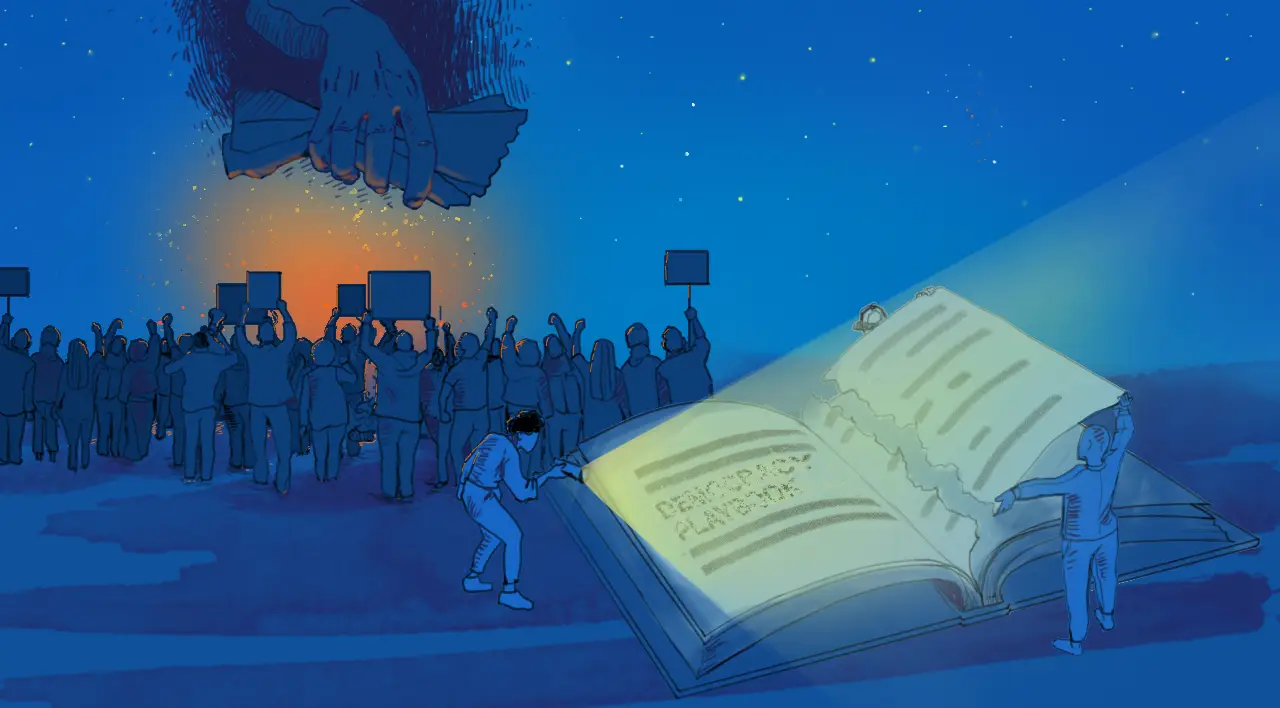
That’s what we are asking with our new project, The Democracy Playbook.
How do people fight for their democracies?
The Democracy Playbook is a global cross-border collaborative project highlighting the successful strategies movements and communities have employed to fight for democracy.
The story of movements fighting for democracy are often told in terms of how they disturb public order, stop traffic, or otherwise interfere in the “normal” functioning of society.
But what if they were reported on as part of a global trend and as a continuing story: opposed to the wave of authoritarianism?
Accurate, context-rich reporting on the movements fighting for free press, the climate, independent judiciary, workers’ rights and more can inspire and show what tactics and strategies work. And they can show that reporting can be truthful and pro-democracy.
At Unbias the News we have never aimed to be “neutral,” and object to the idea that any news outlet can be. Particularly now, aiming to be neutral on threats to democracy and human rights has perverted reporting to the point where headlines needlessly depart from reality. People randomly die in wartime with passive-voice headlines that leave no one to blame, climate protesters are equated with terrorists for mild property damage, and causes are generally separated from effects, to the extent that real news can sometimes add to the confusing slurry of misinformation and propaganda being distributed across our broken social media platforms.
For this project, we want to find stories from the past and present that center on social movements and their successful tactics and strategies for regaining control over their democracies, or parts of them.
By success, we don’t mean that the triumph was permanent, or even the outcome that was originally intended. Movements that galvanized or educated the public about an issue or brought diverse groups of people together for a sustained effort are a success in their own right, and should be learned from as well.
If you have a story that you think the world can learn from as we face a wave of authoritarianism, click the link below to submit a pitch. Otherwise, we hope you will read and share the stories of the Democracy Playbook and join us as we try to learn lessons from the past and present about fighting for democracy and our role in that fight as journalists.
Join us
To submit a pitch, please fill out this form.
We are open to receiving organizational support from institutions interested in backing this project. By supporting us, we can expand our reach to more regions worldwide and demonstrate how a people-driven movement contributes to the sustainability and strengthening of democracy. If you would like to support our work, please contact us.
Related Posts

Foreign capital, local burden: Who benefits from mining in Bosnia?
When foreign companies restarted mining operations that had been shuttered since the breakup of Yugoslavia, Vareš had high hopes of economic revival. But as the state fails to take a stand against pollution and deforestation, optimism has given way to nostalgia for the socially owned mines of the communist era.

“We can only get out of here if we die”: How EU funds to help Roma communities are reinforcing isolation, prejudice and exclusion
Roma people are routinely excluded from jobs, housing and public services. Yet tens of billions of euros to promote Roma inclusion are vanishing into projects with no transparency or measurable impacts. Our investigation found evidence of some of this EU money being spent on displacing or demonizing Roma communities in Hungary, Bulgaria, Czechia and Italy.

Dollar stores, diesel fumes and food sovereignty in Chicago’s frontline communities
In communities shaped by redlining and disinvestment, the only places to shop are often dollar stores – stocked with plastic goods that have crossed oceans on container ships and rolled across states on eighteen-wheelers. These journeys are long, carbon-heavy, and almost invisible, but their impact is felt from Suzhou to Chicago, from the global climate to the human body.

Growing up too fast: Children struggle with aftermath of state violence in India-Bangladesh border villages
India and Bangladesh share a 4,000 kilometer-long border, which looms large for children of living alongside it, particularly those whose parents have suffered abuse at the hands of the Border Security Force.

COP comes to the Amazon: Is Belém ‘ready’ for the gringo’s gaze?
This year’s COP, the UN’s 30th global climate summit, is hosted by Belém. The Brazilian media has become obsessed with Belém’s poverty and underdevelopment – shortcomings that weren’t deemed newsworthy until the urban Amazon became a focus of the world’s attention. But what does it mean to be prepared? For whom?