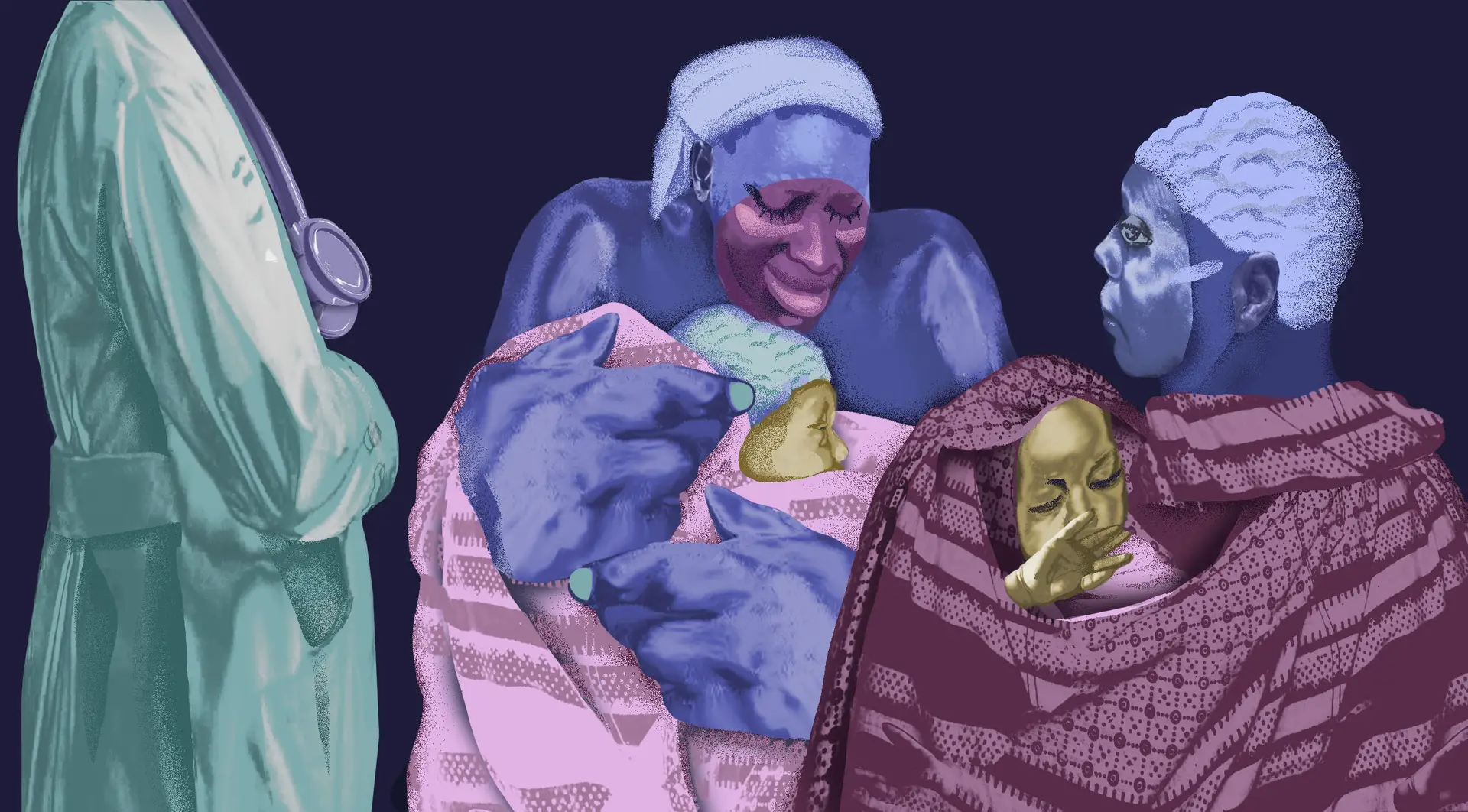
Two women stand by a doctor whose face is not shown. One women wails in grief, another wears a mask, they both hold babies.

For some women, a different kind of pain during birth

Behind the Scenes of "A Living Hell: Kenyan Women Report Physical Assault During Childbirth"

Women across the world, especially in minority communities and developing nations, are at a heightened risk of experiencing life-threatening complications during pregnancy and childbirth.

Even a renowned athlete like Serena Williams revealed she almost died while giving birth to her daughter after suffering from a pulmonary embolism and a hematoma, while singer Beyoncé shared that her children’s  births were potentially life threatening for her.

Sub-Saharan Africans suffer from the highest maternal mortality ratio – 533 maternal deaths per 100,000 live births, or 200,000 maternal deaths – a year, according to UNICEF.

But Tabitha Gateti’s story, which you are about to read, is one that will surely leave you startled. If you’re a woman, you’d have to read this sitting down so you can catch your breath, not to say that men will not be as shocked.

As a mother, this is a story that left me teary-eyed. This is definitely not the first time I am working on a story about maternal health but Gateti’s story is tragically sad and depressing, to say the least. Losing your child once is hard enough. I cannot imagine the pain of having to endure this  loss multiple times. As I edited the story, I held myself back from breaking down.

I am aware this is a familiar story for most women across the continent in some hospitals, not just in Kenya but also in Nigeria where instead of receiving support during labour they get beatings. Women have also had to complain of the same treatment meted out to them by healthcare providers and caregivers. 

Gateti’s story is one that is underreported and never makes it to mainstream media but, with your support, we can tell more of these stories as it affects women across the world.

Please consider a donation to support the work of our all-women newsroom. We create a space for journalists facing structural barriers, working towards a more equitable, inclusive world of journalism. Join our mission today!

Related Posts

Capulálpam de Méndez: A struggle for land and memory

After a Canadian mining company challenged a Zapotec community’s Indigenous identity, recalling the ancestral names of sacred landmarks helped reinvigorate their connection to the land – and defend it from extractive industries.

Sierra Mixe: A conversation with Mother Nature

Medicinal wisdom is embedded in Indigenous Mixe languages. By sustaining their mother tongue and practices involving herbs and healing rituals, Mixe people keep alive a cosmovision in which they speak to Mother Earth.

Workers, miners, citizens cross paths in front of a factory and lake

Foreign capital, local burden: Who benefits from mining in Bosnia? 

When foreign companies restarted mining operations that had been shuttered since the breakup of Yugoslavia, Vareš had high hopes of economic revival. But as the state fails to take a stand against pollution and deforestation, optimism has given way to nostalgia for the socially owned mines of the communist era.

Help us fight for a more inclusive journalism